
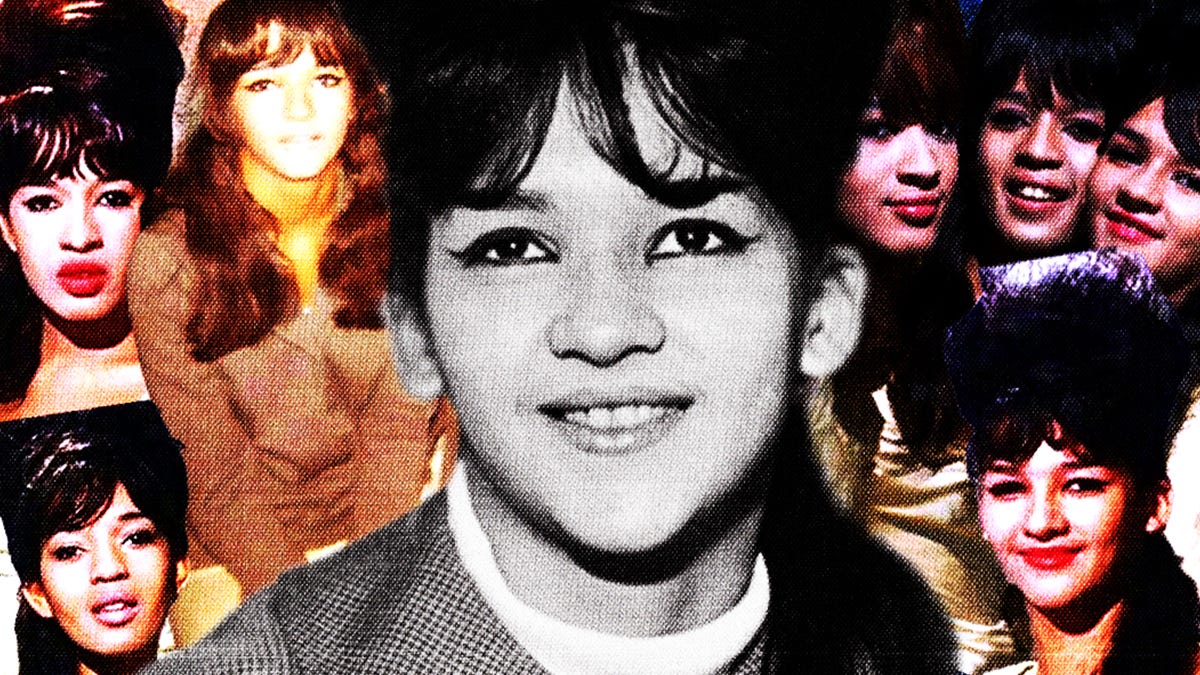
The Evolution of Three-Part Harmony
In Western music, the three-part harmony dates back to the 12th and 13th centuries, when Léonin and Pérotin developed polyphonic compositions that expanded on the early heterophonic harmonies of sacred Gregorian chants. Followers viewed these harmonies as reflective of a spiritual unity: many voices coming together, becoming anonymized for the greater purpose of worship.
In the United States, three-part harmony became an integral ingredient in some of the earliest forms of popular recorded music. Drawing on techniques pioneered by Black gospel and quartet singers, trios like The Boswell Sisters helped codify the Big Band sound of the 1930s. The doo-wop boom of the 40s, though typically anchored by a quartet if not a quintet, at its core generally utilized a three-part harmony structure. Early girl groups like The Chantels employed rich harmony in their pioneering blend of doo-wop, rock and roll, and white pop music. By the time a group of young girls from Spanish Harlem who called themselves The Ronettes came around, three-part harmony was nothing new. But their music would forever change its function.
Nedra Yvonne Talley was born on January 27, 1946, in Washington Heights. She grew up in a multi-cultural, family-oriented Baptist home, where Saturday nights were spent at her grandmother’s house singing with a rotating cast of cousins working out harmonies to perform for the rest of the family. “They would make you think you were really good and then they’d give us money,” she recollects in But Will You Love Me Tomorrow?: An Oral History Of 60’s Girl Groups. “So we started getting paid at 5.”
The Rise of The Ronettes
In 1957, Nedra’s cousin Veronica, known as Ronnie, decided to take advantage of the family’s talents. Ronnie was infatuated with the doo-wop sensation Frankie Lymon and the Teenagers, so she recruited her sister Estelle and their cousins Nedra, Diana, Elaine, and Ira, who spent their weekends perfecting songs like “Goodnight, Sweetheart, Goodnight” and “When The Red, Red Robin.”
When then-frontman Ira got cold feet during the group’s performance of Frankie Lymon’s “Why Do Fools Fall In Love” at The Apollo’s famously cutthroat amateur night, Ronnie took over, and was immediately enamored with the power her voice could wield over the audience. After that night, the group was whittled down to Ronnie, Nedra, and Estelle, who dubbed themselves Ronnie and the Relatives and began cutting their teeth at local sock-hops and barmitzvahs between vocal lessons.
While loitering outside of the Peppermint Lounge in 1961, that club’s manager mistook the girls for the backup dancers of Joey Dee and the Starliters. Nedra and Ronnie, still underage at the time, had their mothers do their hair and makeup to make them appear much older, an exaggerative foreshadowing to what would soon be the girls’ signature look. A bombastic performance led Ronnie and the Relatives to a residency at the lounge, where they would perform as twist dancers and eventually rechristen themselves The Ronettes.
Phil Spector and the Wall of Sound
A chance meeting with promoter Phil Halikus led the group to producer Stu Philips of Colpix Records. It was during their time at Colpix when they perfected their now-iconic stylings of winged eyeliner, pencil skirts, and beehive hairdos—maximalized versions of what they’d grown up around in Spanish Harlem. Along with their uniforms, the girls’ being related deepened their homogenous visual branding, something Nedra noted in an interview with Bruce Morrow: “What was different with the Ronettes was we were family, so we looked alike. We held hands. Other girl groups didn’t have that.”
Following a series of failed singles, The Ronettes auditioned for Phil Spector, who signed them to his own Philles Records. Nedra and Estelle were, unfortunately, afterthoughts for Phil. His initial intentions were to only sign Ronnie, for whom his infatuation would soon prove to be a gift and curse for the group.
Spector had already seen success in the girl-group realm with his recent signees The Crystals. This was a practice he continued with The Ronettes, whose first four songs recorded by Spector were also released under the Crystals name. It was through those experiments that Phil began developing what would become his “wall of sound,” a technique he perfected on the Ronettes’ first major single, “Be My Baby.”
But “Be My Baby” is also a song of intention. It was Phil’s first time utilizing a full orchestra in the studio, as he was determined to create his most sonically colossal recording yet. Most notably, Ronnie is the only actual Ronette to appear on the record. “Be My Baby” was in many ways a culmination of Spector’s obsession with her, and his disregard for Nedra and Estelle.
A Legacy Beyond the Studio
The success of “Be My Baby” was a double-edged sword. On the surface, it turned The Ronettes into an international sensation. But it also sowed the division that would lead to the group’s demise. Phil Spector’s obsession, abuse, and dehumanization of these women fundamentally altered their art—and more importantly, the trajectory of their lives. In a public sense, the most damnable thing he did was reducing the Ronettes’ legacy to a single song—a song only one of them appears on.
A year before the Ronettes split, Nedra traveled to Maryland with her then-boyfriend, New York disc jockey Scott Ross. It was there that she received a vision from God and returned to New York a born-again Christian. This spiritual revelation led Nedra to question her place in the group. Drawn toward Christian music and feeling constrained by the secular demands of pop and rock, she found herself increasingly at odds with the group’s direction.
Nedra’s debut solo album, 1978’s Full Circle, is a testament to her talent. Her lifelong dedication to the three-part harmony is present to the extent that, if you tune out the overt religiosity, it conjures an idea of what a Ronettes record might have sounded like had the group survived to explore the world of ‘70s funk and pop-soul. The album is produced entirely by her husband, which further negates the notion that the brilliance of any of the Ronettes was due entirely to any Spector not named Ronnie.
A three-part harmony is defined as three individual voices coming together to form a singular chord. When done correctly, each unique voice gets lost, and the sound becomes something greater than the sum of its parts. Nedra Talley passed away in her Virginia home in the early hours of April 26, 2026. Today we honor her as a singular voice, one greater than the sum of its parts. An essential piece in advancing centuries-old traditions, and changing music as we know it in the process.