
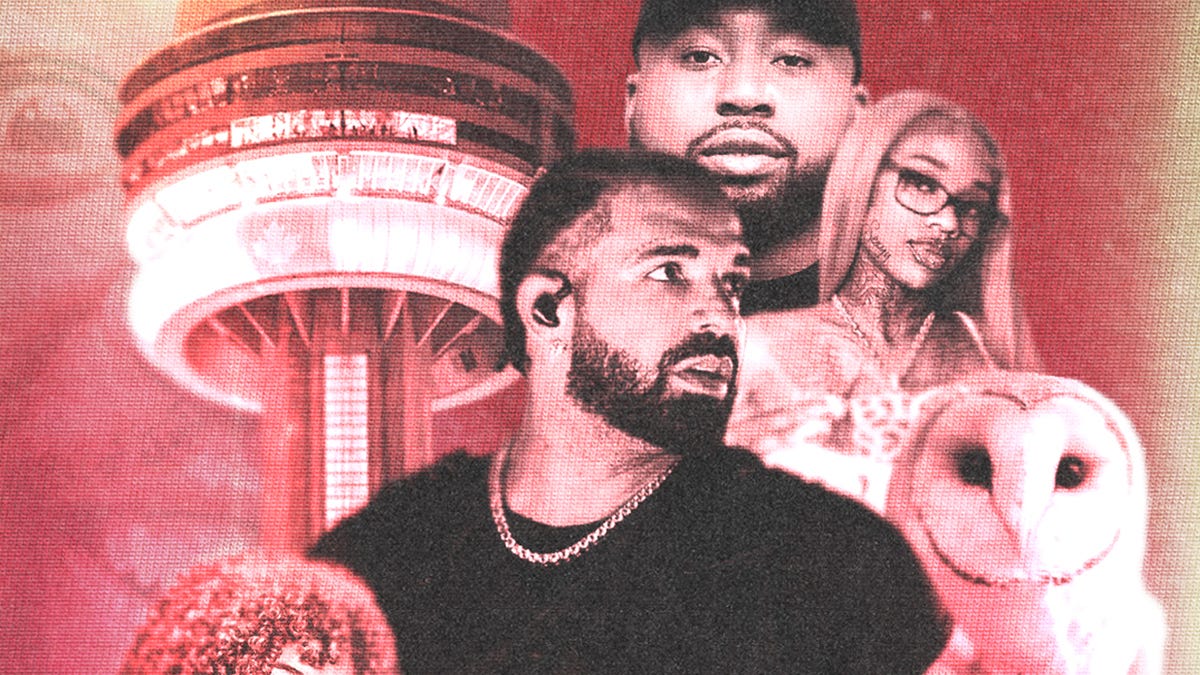
The cover of Iceman, the marquee album among the three Drake released last week, is a picture of a disembodied hand wearing a crystal-studded glove. In 2023, to celebrate matching Michael Jackson’s 14 No. 1 singles, Drake bought one of Jackson’s signature accessories for a reported $123,000—a move that fits the gaudy, slightly obnoxious persona one might expect from a global superstar with such accolades. However, the world that Iceman enters is darker than the one we inhabited in 2023: more naked in its cynicism and more transparent in its malice. While critics and fans have long complained about Drake’s circular writing and emotional stagnation, this new project—comprised of Iceman, Habibti, and Maid of Honour—finds the artist spiraling deeper into the ruts that have defined his career for nearly two decades.

This isn’t always for the worse. At times, the neuroses reach the necessary escape velocity to break free from Drake’s preening self-awareness. There are stretches of inventive, intoxicating production, especially on the front half of the dance-oriented Maid of Honour. While his syntax can still be exhausting, there are moments of accomplished rapping across Iceman, and Habibti—which strains to recapture the gravity of his early R&B records—is notable for its smartly chosen collaborators. The triple-album gambit is a brilliant, Sun Tzu-style maneuver, and for the first time since 2016’s Views, there seem to be actual narrative stakes to his work. Still, there is something remarkably deflating at the project’s center.
The glove remains a central motif. Early in 2024, on Future and Metro Boomin’s “Like That”—the song that made long-simmering animosity fully legible—Kendrick Lamar quipped that Prince outlived Michael Jackson. Across Iceman, and occasionally on the sister LPs, Drake seems consumed by his beef with Kendrick, which culminated in “Not Like Us” and stands as one of the most resounding losses in rap history. What is frustrating is that Drake remains a prisoner of his own need to appear unbothered. When he confesses on the opener “Make Them Cry” that a “big piece” of him died with the feud, it feels less like a confession and more like an engine for grievance. He is pathologically non-specific about the substance of the beef, turning it into an amorphous cloud of victimization.
In places, this fixation is simply embarrassing. How can one rap agitatedly about LeBron James betraying them while sporting a tattoo of the man? The near-constant flitting between feigning confusion as to why anyone cared about the disses and reminding listeners of his own status would be compelling if the hurt or the indignance scanned as anything other than a pose. Yet, the one true cardinal sin in art is not to be ideologically offensive or derivative; it is to be boring. Drake’s incessant references to streaming numbers and the payola schemes he alleged in his now-dismissed lawsuit against Universal Music Group are numbing. Attempting to recast that suit as a form of Robin Hood altruism is preposterous, and ultimately, it is difficult to care about the mechanics of the industry when the music itself feels so detached from genuine stakes.
While Drake has made a career by vampiring emergent regional sounds to support his chart supremacy, he wisely avoids attempting that with contemporary Los Angeles. Yet, even when he calls his shots, the records sag under the weight of malformed attempts at retribution. Iceman features surefire hits in the glittering “Shabang” and “Janice STFU,” but both songs sputter when they get stuck on an enemy Drake claims never bothered him in the first place.