
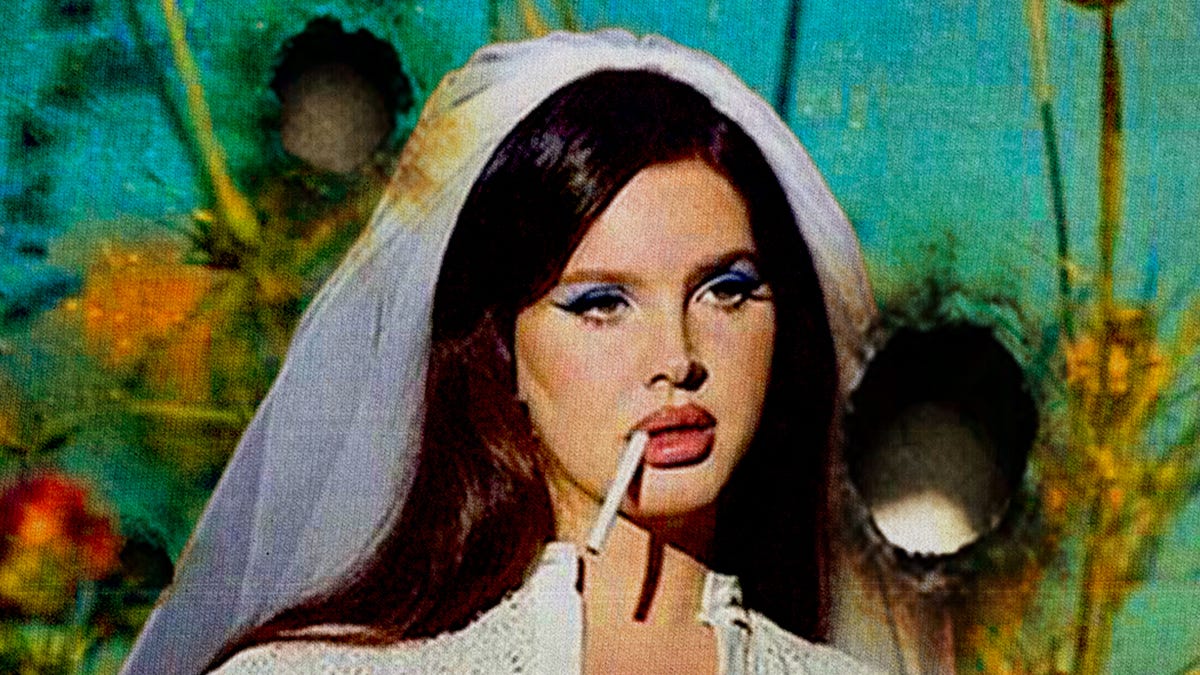
The Genesis of an Obsession
Just as my parents remember where they were when we landed on the moon, I remember where I was when I first saw the music video for Lana Del Rey’s “Video Games.” Osama bin Laden had just been killed, my peers were Occupying Wall Street, and I was high as a kite in my Berkeley studio apartment, watching Lana sing “Heaven is a place on Earth with you” through artificially puffy lips.
I’ve always had trouble caring about the things I’m supposed to care about and had an easy time caring way too much about things considered trivial. I couldn’t get it up for Occupy, but something about archival footage of ‘70s California skaters and paparazzi clips of Paz de La Huerta falling down drunk paired with this Priscilla Presley lookalike cooing sublime melodies felt so earth-shatteringly important to me.
A Decade of Devotion
I can be a bit of a fair-weather fan. Throughout my life, I have had short-lived but incredibly enthusiastic obsessions with Christina Aguilera, Avril Lavigne, The Postal Service, Uffie, Sleigh Bells, and A$AP Rocky. I recently had a brief fixation on Billie Eilish after becoming enthralled by her vocals on the Barbie soundtrack, peaking when she made a very lesbian album and told Rolling Stone she wanted her “face in a vagina,” and deflating entirely when she got a boyfriend shortly thereafter. But my Lana fandom has outlasted them all; in 13 years, she’s never disappointed me once.
Not when she sang “he hit me and it felt like a kiss” (it’s homage), not when she dated a cop (he was hot), not when she called feminism “not an interesting concept.” Not for wearing a COVID mask made of crystals, not for posting a mirror selfie of herself with a gun, not for all the missed album deadlines, and not even when she leaked a diss track about my queen Ethel Cain. I would be so flattered if Lana wrote a diss track about me.
Vulnerability as Art
The main criticism flung Lana’s way early in her career was that she was “fake,” I suppose because she had a fake name and Juvéderm-plumped lips. But Lady Gaga, who was hugely popular at the time and actually named Stefani Germanotta, was literally wearing prosthetics on her face and arriving at award shows inside an egg. When I look back at that notorious SNL performance, I don’t see fake; I see someone who is terrified. I suspect it was her vulnerability that made people uncomfortable.
We tend to expect our female pop stars to be fierce, tough, and swaggering. But Lana’s not a girlboss, nor is she vengeful. She’s delicate, she’s shy, she still loves her man even after he treats her like shit. The way Taylor Swift and Beyoncé play for 95,000-person audiences without showing an iota of nerves? Impressive, but a little alien. I often think of an early YouTube video where a fan asks Lana how she prepares for a show. “I freak the fuck out,” she says. Is there a simpler, more relatable way to express the sheer horror involved in sharing your art with an audience?
Finding Solace in the Sound
Just as my parents remember where they were when Pope John Paul II visited America, I remember where I was when Lana became a religious figure to me. It was New Year’s Day, 2015. I was hungover in my studio apartment in Oakland, California, a city where I had very few friends. I felt so profoundly alone. On the plus side, I loved my haunted Tudor building that still allowed smoking. The last person who’d lived in my studio had died in it, and I felt her presence all the time.
As the sky became that electric navy blue it gets just before turning black, and “Shades of Cool” was playing for probably the 15th time that evening, I felt my sadness morph into something more tolerable. I was still lonely, but it felt less pathetic. Suddenly the dark feelings I’d been plagued by my entire life felt glamorous, transcendent, holy.
The Evolution of a Muse
As with most of my opinions that are initially shunned, my Lana fandom was vindicated by time. By the release of Norman Fucking Rockwell! in 2019, critics who once called Lana an industry plant were now hailing her as the poet laureate of American malaise. In 2021, Pitchfork reappraised its review of Born to Die—originally dismissed as “limp and pointless”—and declared it a prescient album capturing “the fulcrum point where the fear and pain of sexualization start to work as leverage.”
The novel that was born from that transcendent moment at Universal CityWalk is called American Spirits, named for both the cigarettes the main character smokes constantly and the ghosts of American culture she channels. It stars a niche legend named Blue Velour. Over the course of the novel, Blue goes from being a nihilistic provocateur to someone more sincere and optimistic, from someone willing to die for her art to someone who wants to live for it. Lana’s career has taken a similar trajectory.
The shifting cinematic universe Lana has built, I imagine, hasn’t been just for fun; I assume it’s a matter of survival. In her music, Lana’s gone from pushing people away with her cleverness to letting her audience in on her most vulnerable struggles. It’s easy for me to see how making music has made room for this to happen because creating art has saved me, too. Writing has gotten me through some of the darkest periods of my life. It’s given me a friend when I’ve had none. It’s made the constant noise inside my brain tolerable. It’s calmed me down, it’s cheered me up. It’s introduced me to people I never normally would have met and taken me places I never normally would have gone. It has also left scars.