
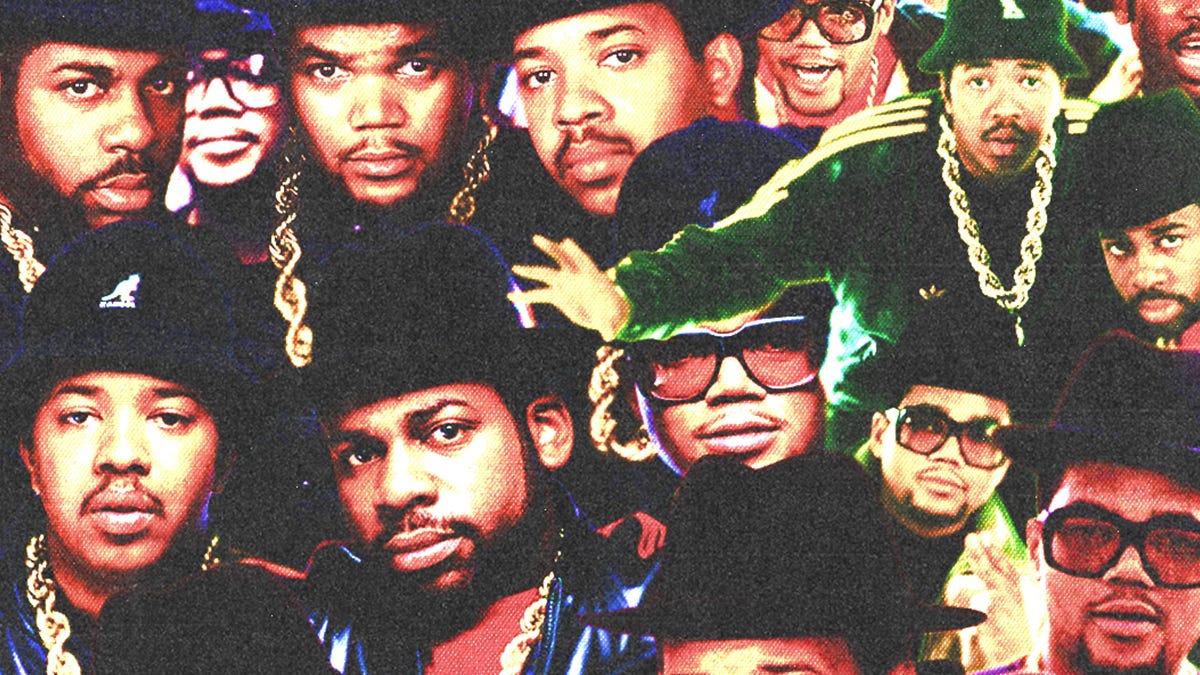
You shouldn’t trust people who claim they’ve invented something. In hip-hop, as in life, everyone is a transitional figure—a tenuous tie between the past and the future. The common narrative surrounding Run-DMC suggests they mutated rap from the primordial, neo-disco ooze of its early recorded days into something sparer, tighter, and more kinetic. If you internalized the tidy narratives of countless books and documentaries, you would be forgiven for believing this. It is a compelling story, but it misses the nuance of the artists themselves.
From the time an obsessive party promoter named Russell Simmons was shown the high school diploma he demanded from his kid brother, Joseph “Run” Simmons, Darryl “DMC” McDaniels, and Jason “Jam Master Jay” Mizell insisted they were part of a sacred, albeit temporarily broken, lineage. By the time they became a global sensation, DMC would rap that he and his partners “took the beat from the street and put it on TV.” This wasn’t just a simple commercial shift; it was a reclamation of the spirit of the live routines that had enamored them long before they ever stepped into a recording booth.
The Blockbuster That Changed Everything
Released 40 years ago this month, Raising Hell was rap’s first true blockbuster. By July, it had been certified Platinum—a first for the genre. Their collaboration with Aerosmith on “Walk This Way” was a pivotal moment, forcing the industry to acknowledge hip-hop’s viability and securing the group a permanent home on MTV. The album codified stylistic quirks—the precise rhythms of the tradeoffs between two MCs and the iconic sweatsuits—as the core tenets of a culture.
Yet, the history of Raising Hell is incomplete without acknowledging how quickly the sea change it brought left its creators in deep water. The following year saw the debuts of MC Shan, Ice-T, Boogie Down Productions, Public Enemy, and N.W.A. The animated style that made Run and DMC stars was suddenly being challenged by the cool, detached delivery of artists like Rakim. “Walk This Way” was quickly cordoned off as a museum piece, a relic of a specific moment in time.
The Genesis of a Classic
The album’s creation was an act of intense recalibration. Following the success of King of Rock and their appearance in the film Krush Groove, the group was exhausted from a marathon tour. They wanted a sound that was even more stripped down than their previous work with producer Larry Smith. While on the road, they wrote nearly every lyric that would eventually make Raising Hell, testing the material live before ever entering the studio.
The tracks were recorded over three months at Chung King Studios with a young, then-little-known producer named Rick Rubin. Rubin urged the rappers to stay within themselves, to remain poised and keep a little in reserve. This control is evident on tracks like “Hit It Run,” where DMC displays a level of restraint that had not been present in his earlier work. Even the Slick Rick-inspired “Perfection” is anchored by a calm that took years to develop.
The Legacy of Ineffable Cool
Cool is an elusive quality, often redefined without notice. In 1986, no one possessed this gravity quite like Run-DMC. When DMC raps about the charitable success of Live Aid on “My Adidas,” it sounds like a boast as potent as any about wealth or status. It was this ineffable cool that ferried the group through the “Walk This Way” sessions. While it was Rubin’s suggestion to re-rap the lyrics, it was Jam Master Jay who convinced his partners to commit to the idea, recognizing the inherent flow in Steven Tyler’s delivery.
DMC has long maintained that the greatest period of hip-hop existed before “Rapper’s Delight.” As he noted in a 2023 appearance on the Drink Champs podcast, the commercialization of the culture was a double-edged sword. “Anything that is holy or sacred to a nation, a community, or a people will get diluted, polluted, or destroyed once it’s commercialized,” he reflected. “But if there was no music business, we’d still have hip-hop.”
Ultimately, Raising Hell remains one of the genre’s most essential albums because it represents the precise point of convergence between popular potential and the raw, unmonetizable culture from which it emerged.