
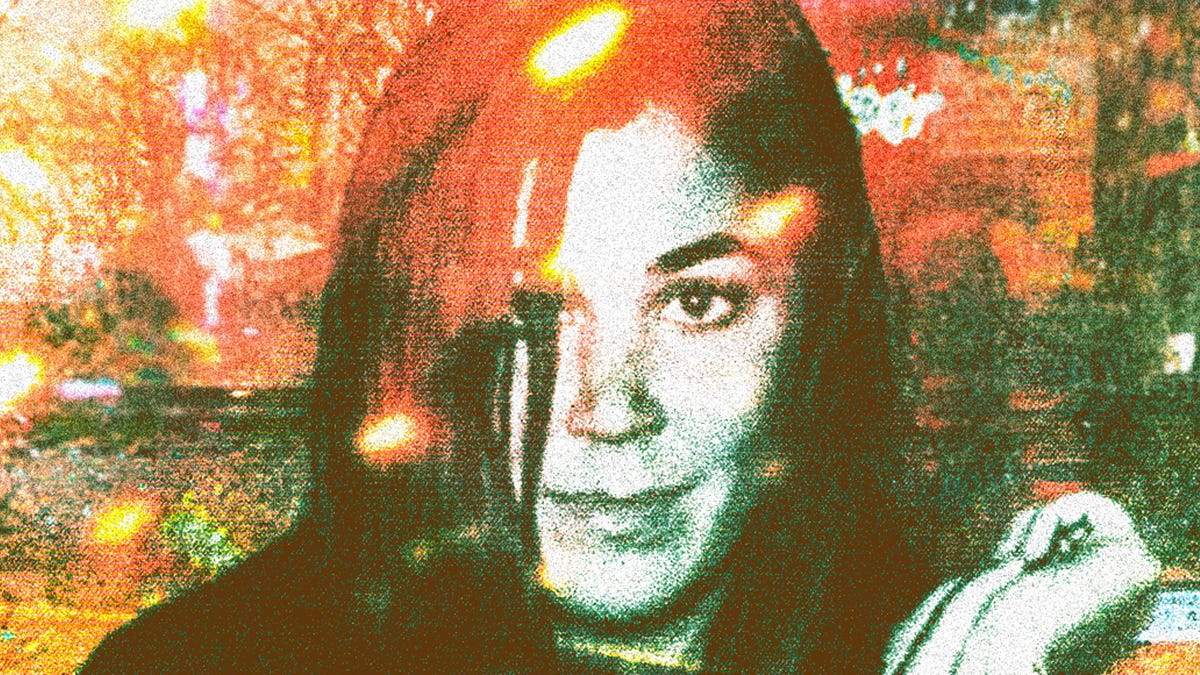
Toward the end of Midwestern Death Trip, her richly detailed history of a region and war-report from its bars and supper clubs, Meaghan Garvey raises an existential fear. “What did it mean that every writer I admired had drank themselves to at least temporary ruin? And was I crazy to believe that 20 years of drinking had given me more than it had taken away?” she asks. As it so happens, that question comes at the bottom of a page. At the top of the next one, a hand-wave slyly loaded with an actual philosophy: “Anyway, never take life advice from people who hate life.”
Meaghan has often been described as one of the most vital voices on the internet. Her Substack, SCARY COOL SAD GOODBYE, serves as an evocative, idiosyncratic archive of a career that began in music criticism and has since been refracted through the lens of early adulthoods warped by the digital age. Death Trip marks a departure from the screen, following her journey in a 1993 Cadillac Coupe DeVille across the Midwest, resulting in a portrait of both a distinct society and a singular literary protagonist.
The Genesis of a Midwestern Odyssey
When asked about the origins of her book, Garvey admits that it was less a grand ambition and more a nudge from the right person. “I kind of am not that ambitious unless I’m prompted to be,” she explains. “I probably would’ve never done this had my editor not sat me down at some fancy party a year and a half ago and been like, ‘I want you to write a book. I want it to be called Midwestern Death Trip. And in it, I want you to figure out what the fuck is your problem.’”
Reflecting on her youth in Oak Park, Illinois—the birthplace of Ernest Hemingway—Garvey recalls a childhood defined by a desire to escape. “I would’ve said, ‘It’s fucking boring as shit, and I can’t wait to leave it and go to some coastal city and become a great artiste,’” she says. “I wasn’t a loser, but I didn’t really have my people, so I just always thought the action of my life would start after I left. And that basically turned out to be true.”
From Music Critic to Cultural Observer
Garvey’s path to New York was unconventional, marked by a brief, ill-fated internship at The Fader and a sudden marriage. During that era, she gained recognition as a music critic, though she maintains that she never set out to be one. “I considered myself an artist, a visual artist,” she notes. “I really wasn’t trying to be a music writer—or a writer whatsoever. But I think I just was so annoying on Twitter that finally someone was like, ‘Here’s $150, please shut the fuck up.’”
Looking back on the 2012 Chicago music scene, she describes it as an electric, pre-algorithmic time. “It was a pure pleasure to spend your day on the internet and go to sleep thinking, ‘day well spent.’ It wasn’t as nihilistic and scammy and culture war-ish and mean-spirited. It was fun to spend your time online.”
However, she admits that the industry took its toll. “I feel like my identity was so entwined with music and culture and criticism that it almost stunted my ability to figure out who I was outside of my taste and preferences,” she says. “I feel like when a lot of your relationships are premised by my opinions and taste, it’s like a proxy for a relationship, not a real relationship.”
Finding Life Beyond the Screen
Today, Garvey finds grounding in her neighborhood in Rogers Park, Chicago. She emphasizes the importance of local connection—becoming a regular at bars and knowing her neighbors—as a way to move away from using taste as a proxy for identity. “I think it was tied to owning the place where I lived and just leaning all the way into it,” she explains.
When asked about the artists who influenced her transition to long-form writing, she points to Lucia Berlin. “Who I replaced [Eve Babitz] with is Lucia Berlin, who I just think is the fucking dopest writer of all time because she, it is jacarandas and bougainvillea and tacos and Mexico, but it’s also like, ‘I am drinking Jim Beam at seven in the morning before my kids go to school, and I just crashed my car and now I’m in jail.’”
Ultimately, Garvey views her work as an attempt to capture the spirit of the American experience—a triumph of will over reason. “I like people who kind of seem like they got the shit kicked out of ‘em,” she says. “I like people who lived a sad life confidently, or who did batshit things with confidence.”