
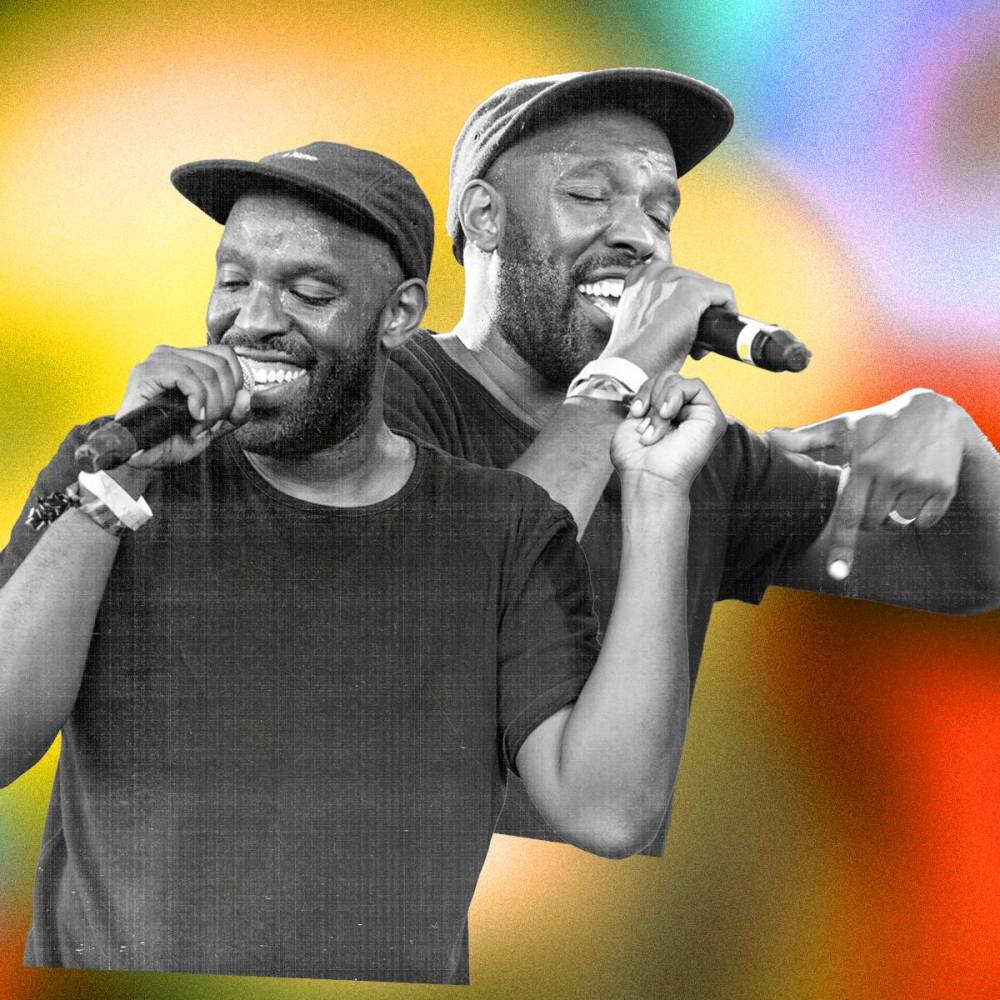
Art by Evan Solano
Dash Lewis wants someone to pour that foaming shit from rug cleaning videos all over his brain.
A few minutes into our two-hour chat, Canadian hip-hop legend Shad and I have landed on the topic of middle age. Specifically, as two men with a foot inside its door, we’re contemplating how it feels to suddenly realize that our conversation with the cosmos has shifted. If your 20s are all about limitless expansion and your 30s are a settling and refinement of perspective, what’s left for your 40s and beyond? Hip-hop itself has just rounded the corner on 50, and we’re in the strange new territory of legacy-act comebacks and the sudden, tragic passings of rappers reaching the height of their powers. There’s a wealth of records infused with the wisdom, curiosity, and apprehension that come with realizing there are fewer days ahead of you than behind, and a lot of defensive, acerbic Old Head discourse about what hip-hop should be. “There’s never been a rap song about getting a colonoscopy,” he says, eyes widening as his open palms float into the center of the Zoom window. “That would be a fantastic thing to write about!”
Start Anew, the 43-year-old Canadian’s latest album, isn’t explicitly about aging, but it is undeniably one of the record’s many colors. It’s contemplative and probing, imbued with the depth and contour of someone who’s lived through more than a few cycles. There’s a roominess to it, each sound rendered in crystal clarity. The weight of mortality lurks in the background but doesn’t command the spotlight; Shad’s more concerned with the patterns and habits that propel us towards it. What’s in our control? How do we find joy and presence? What does inevitability really mean?
Shadrach Kabango was born in Kenya to Rwandan parents and raised in London, Ontario, a city so powerfully ordinary—mid-size, middle-class, multi-ethnic—that it serves as a focus-group testing ground for Canadian corporations’ newest products. “A city of consumers, not producers,” as he puts it. Despite having nearly half a million people, London didn’t boast much of a scene to speak of, its most famous export being bandleader and “Auld Lang Syne” composer Guy Lombardo.
But if you pick a direction and drive two hours, you’ll hit Detroit, Toronto, or Buffalo, cities with vibrant musical identities that have well-stocked record stores and radio stations with enthusiastic, tastemaking DJs. “I felt on the outside of places where the stuff was being made,” Shad explains. “[In London], we weren’t able to touch it. We fantasized and dreamed about it, which built a lot of hunger and a desire to get really good if we wanted to participate someday.”
Shad spent his teen years poring over albums like Common’s One Day It’ll All Make Sense, OutKast’s Aquemini, and Ras Kass’ Soul On Ice, all of which he describes as “absolutely mind blowing.” That Common could so fluidly switch between acid-tongued shit talk and philosophical grappling gave him a sense of how variegated songwriting could be; OutKast’s Southern mystique and soupy, humid funk taught him about the transportive properties of a bassline or a rubbery flow; listening to Ras Kass was like a history lesson delivered via open-palmed slap. He started rapping for fun, mostly trying to make his friends laugh at clever punchlines, but once he learned that a song could have heft and gravity, something unlocked.
“Hip-hop allows me to be a whole person,” Shad says. “It allows me to really exist in the world with much more lightness and to be kinder, more patient, and more accommodating, because I get space to be all these different parts of myself.” In some of the interviews André 3000 gave around New Blue Sun, his polarizing New Age album that featured a song titled “I Swear, I Really Wanted to Make a ‘Rap’ Album But This Is Literally the Way the Wind Blew Me This Time,” he wondered if, at 48, he had it in him to write about his worsening eyesight or proctologist appointments. In Shad’s view, it was a missed opportunity for one of his heroes to introduce a new point of view. “It’s crazy invasive and embarrassing, but also, I have two small kids that I want to stick around for. Why not make a song about that?” he wonders. “It’s not ‘Bombs Over Baghdad,’ but it kind of is, you know what I mean?”
Over the past 20 years, Shad has steadily become one of Canada’s most celebrated cultural icons. Since his debut, 2005’s When This Is Over, financed by the winnings of a London radio station’s talent contest, Shad has built a consistent, challenging body of work. In between the steady stream of records and EPs, he’s branched into radio and television, with stints hosting Q, a long-running arts magazine show on CBC Radio One, and Hip-Hop Evolution, a four-season Netflix documentary series. He won a Juno award in 2011 for his album TSOL, and has been shortlisted for the Polaris Music Prize more than any other artist in the award’s history.
Shortly after the release of Start Anew, Shad and I had a wide-ranging conversation that took an overhead view of his career. There’s a through-line in his work, in whatever medium he’s working, of curiosity and empathy, of responsibility and care.
That voracious desire to learn and synthesize is as present today as it was in his London youth, trading tapes of bootlegged Detroit radio broadcasts with his friends. Even as he looks back on a long career dotted with milestones and detours, Shad remains fascinated by its potential. Chapters may close, but the book is still open. “It’s okay to be at the end,” he says definitively. “There’s always going to be something else, but who knows what it is.”
It’s so strange to think back to that time. It feels ancient in the music industry because recording music was so hard. You had to go to an actual studio, which was really expensive. It wasn’t this laptop, Garage Band, Logic era. Winning the contest was important for me, practically speaking, to be able to make that album, but it was also the first time people who weren’t my family or friends said I was good, and that matters. That matters absolutely.
My sister encouraged me to apply. I had to submit a demo of a song and an electronic press kit, or EPK, as we called them back in the day, which was a couple of photos and a bio. From that, they selected 10 artists to perform, and industry judges graded their performances. They chose three winners: a solo male, a solo female, and a group, and each of us got money to record an album. Radio stations had to contribute to a fund to develop new talent as part of their broadcasting licenses, so they did so by creating this contest. The station had to pay the money directly to studios and producers. They were making sure they weren’t cutting you a check. It was to actually finance an album. That’s all that was involved.
What I remember most is how little I knew; it’s crazy. [Laughs] I remember the ordeal of booking a studio—looking in the Yellow Pages for recording studios, finding one, booking it out, and sitting in front of the mixing board the first day and going like, “Oh, wow. I don’t know what any of the stuff does. I know how to rap, and that’s all.” I hardly even knew people who made beats! Maybe two people in your city make beats, because who can afford a beat machine? Who knows how to loop stuff up? Let alone if they’re good! I only knew two, maybe three people who made beats, so I had to go online and talk to friends of friends.
I’ve actually used the same approach every time I make songs since then. I’ve figured out a lot; there’s obviously quite a bit I’ve picked up over the years, but still, every time I’m making a song, I’m going through this process of fumbling around in the dark until it gets somewhere close to the idea I had in my head. I remember on Q on CBC Radio, I got to interview Paul Simon, and he was like, “Making albums is really easy.” I was struck by that because I was like, “It’s not easy for me! I’m always trying to figure things out.” I didn’t say that back to him, but that’s what I was thinking. But he’s like, “I write a song. I know exactly how it’s going to be arranged. I know how it’s going to start, how it’s going to end. I know exactly the session players I’m going to bring in to play them. I know who’s going to record it, and it should be done in a week. It’s so easy.” My process is basically still trial and error.
There are a couple of factors here, and one is timing. When I started my career, the internet was in a different place, and the border was a firmer, more difficult thing to cross. I don’t think I played a show in America until 2008. I’d been on the ground in Canada, maybe not established yet, but I was doing things here for like three years before I could even really cross the border once. Another thing that happens with that timing is that I’ve established a career in Canada, and my albums are a conversation with my audience, who are mostly here. So if someone is listening in from across the border, they might not understand the conversation because they’re jumping in midway.
Canada is different. How exactly is it different? I’m blanking, but this is the water I swim in, so it’s hard for me to put my finger on it. I can think of, say, an artist like Drake. Drake was eventually understood in America. And there was, obviously, a lot of money and stuff behind making sure that was grasped. But we understood Drake right away.
An even better example is Snow. I understand Snow, like, that’s that guy. [Laughs] He grew up in the hood around a lot of Jamaicans, and I get that. That’s Darrin. But in America, they were like, “What is happening?” I mean, a lot of Canadians were like that, too. [Laughs] So, not that I’m like Snow or Drake, but there are some things that Canadians just get about me that an American audience doesn’t understand as easily.
It all happened really, really fast. A very popular former host was dismissed in 2015, so they were on a search for a new one. At this time, I’m like most people in Canada, just observing this unfolding search. Then I got a message asking if I’d be interested in guest-hosting. It sounded fun, so I said yes. That stint was four or five days, and then the conversation started to be, “Hey, would you be interested in doing this on an ongoing basis?” A few months later, I started.
I learned to welcome a guest and disarm myself first, and that the guests, as accomplished as they may be, are nervous. You’re anxious too, but it’s your job to remember that they’re nervous and to care for their nervousness before your own. For most people, their own lives aren’t interesting. So, if you’re the interviewer, you have to reflect to them that you’re interested, that it is interesting. And then suddenly they’re like, “Oh yeah, that was crazy.” That’s part of my job as the host: to remind people that, no, your life and experiences are fascinating. Suddenly, they almost rediscover their own story and how amazing it is.
It being live was really fun. I didn’t like pre-tapes. Those were less pressure, but I didn’t like them; they weren’t as entertaining or engaging. Performing is fun, and there’s something about the urgency that helps me focus, pay attention, and be really present. That was an interesting thing to learn. And even when the interview is going off the rails, when it’s live, it’s interesting. I always say that the second-best thing is when you play a show, and something horrible happens. The best thing is if it goes amazingly, and the second best thing is if it goes horribly, because at least something exciting’s happening—the people are getting a show.
I was always inspired during those times. It was like, “Oh man, I just talked to Paul Simon. And then tomorrow I’m in the studio.” I picked up an appreciation for history. Like, say, interviewing Q-Tip or Big Boi and learning about how they made albums, how much they knew about music, and how that was actually a key to those records being so great. Q-Tip understood they’d be sampling a record Ron Carter played bass on, so they needed to bring in Ron Carter—“We can’t bring in just any bass player. It’s him, it’s his hands, it’s his sensibilities.” Being a student in that way makes such a difference. Outkast was the same—they had Cameo’s bassist play with them.
There’s a production company here in Toronto called Banger Films. They made Metal: A Headbanger’s Journey, which is considered the definitive metal documentary series. Based on its success, they were like, “We should do something like this for hip-hop, because that document doesn’t really exist.” There are obviously hip-hop history documentaries, but there’s not that go-to one. They hired this guy, Darby Wheeler, to direct. I know him because he used to program Rap City on our version of MTV, MuchMusic, and he directed another show on the CBC, so I’d crossed paths with him before. Then they hired this writer, Rodrigo Bascuñán, who ran Pound Magazine, which was essentially the Canadian version of The Source. I was a huge fan of it, and I’d been in that magazine, so I knew Rodrigo. As they were looking for a host, they reached out to me, and I just immediately said yes, of course. I’ve never done this, but why wouldn’t I?
We made the first season for HBO Canada, thinking we’d only make one season. Netflix had a show called The Get Down, and it was a big moneymaker for them. It was during that era of Netflix, where they wanted to buy everything, and I think our show made sense. They put the first season on Netflix worldwide, and it did pretty well, so they ordered three more seasons.
It’s funny, the things I learned from Hip-Hop Evolution are obvious, like getting a full appreciation for hip-hop as New York culture. We traveled to New York a lot to interview people, and I remember at a certain point it suddenly clicked for me—this is really New York culture, and this is why hip-hop evolved in the way that it did. The South had to win its respect, LA had to win its respect, because it really is so sincerely New York.
I also remember realizing that hip-hop is electronic music. I came into it rapping, so I never thought about it, never fully appreciated it, or studied it. I suddenly understood how much that matters, and then brought that to my own music—these turntables, these sampling machines, this sound from this keyboard. Hip-Hop Evolution made me understand this is really what it is. That’s why an album like 808s & Heartbreaks blew everyone’s mind, but to someone who understands the history, it’s like, no, that was entirely possible and right there on the table.
I was happy to be nominated, but of course, I didn’t think I’d win. The Junos are our Grammys, so they’re the industry award, right? They reward the music, but they also reward the success in the industry. In that sense, I figured there’s no way TSOL would win. But I was definitely gonna go. There’s a gala, and you get a free meal. It’s great to be nominated, and that’s what it is.
Much like the Grammys, Sunday night is the televised thing. When I won, it was the day before, so it wasn’t the televised portion. I remember going up on stage, and I didn’t have a speech, so I said whatever I said—I can’t remember what it was. Then I remember leaving, meeting my manager outside the gala doors, and we both burst out laughing. It was really fun. It was exciting and hilarious.
These albums have been an attempt to express my sense of things as I look out at the world. I’m trying to figure out how we can live and be together. There’s a problem of peace. Human beings have a really difficult time being together. Lately, I’ve felt like we need to properly appreciate how hard it is.
This may be controversial, but Canada is 40 million people, and Canada Day, for very good reasons, has become very fraught. I understand and really resonate with that, but I also live in a house with my wife, two kids, and my brother. I know how hard it is for five people to get along, so for 38 million people to not be killing each other is no small thing. Maybe that’s worth a party once a year. I hope I’m not too flippant saying that, but those albums are about the problem of getting along.
There’s something that’s not discussed enough about our fear of death, our fear of endings. Not death necessarily in terms of mortality, but capitalism has this imperative that things go up. It’s a fear of impermanence. This unrealistic drive to have things grow perpetually is not natural, and we’re all infected by that mindset in so many ways. We’re kicking and screaming against the nature of things all the time, so maybe that’s part of what’s going on with a lot of these tensions. That felt like my last thought when I look out at the world, and I try to understand what’s going on at bottom.
The first of those three albums, A Short Story About A War, centers on different factions fighting. That led to the next album, TAO, and Start Anew feels like the conclusion to the process of trying to make sense of all these changes and tensions. I could tell from the outset that this was the end, the last chapter in that.
At a certain point, I noticed a dividing line in my catalog: The first four albums were me telling my story, processing who I am and where I’m going. Typical young man stuff. I distinctly remember, after [Flying Colours], feeling like I was through with telling that story. Since then, I’ve been more inspired to reflect on the world and my sense of things as I look out into it. I’m less interested in myself and in what I call the “ongoing saga of so and so” raps, where you’re getting the next diary entry. Our world has started to morph in bizarre, unexpected ways, so the last three albums have felt like me trying to gather my thoughts on all that, trying to put it in a way that feels more interesting than just giving my take on whatever the hot-button topic is.
I went on a journey through many of my albums, exploring the music, production, and the like. My first album was very simple, partly because that’s essentially what I could execute. From there, the albums grew increasingly musically ambitious; the last two have become increasingly simple. Start Anew to me is very basic, meat and potatoes, beats and rhymes. I wanted to return to a very stripped-down sound; it feels more interesting not to add anything to these beats than to add to them right now.
I embrace the challenge of what it means to be a rapper my age. It’s a growing space in hip-hop. What is my contribution to that? How can I step into that and say something that feels honest? What does it feel like to be 43, to look out at the world, and to give my sense of things at this age versus when I was 26? In songs like “Look Pt 1” and “Pt 2,” I’m reviewing my life. I’m talking about the process you go through in middle age: trying to look at reality and stay healthy; trying to be kind to yourself; seeing how far you’ve come and celebrating that, but not being afraid to look at complex things. When you get to middle age, you realize that’s how people get stuck in horrible patterns—when they simply won’t look at the reality of who they are.
We rely on your support to keep POW alive. Please take a second to donate on Patreon!
