
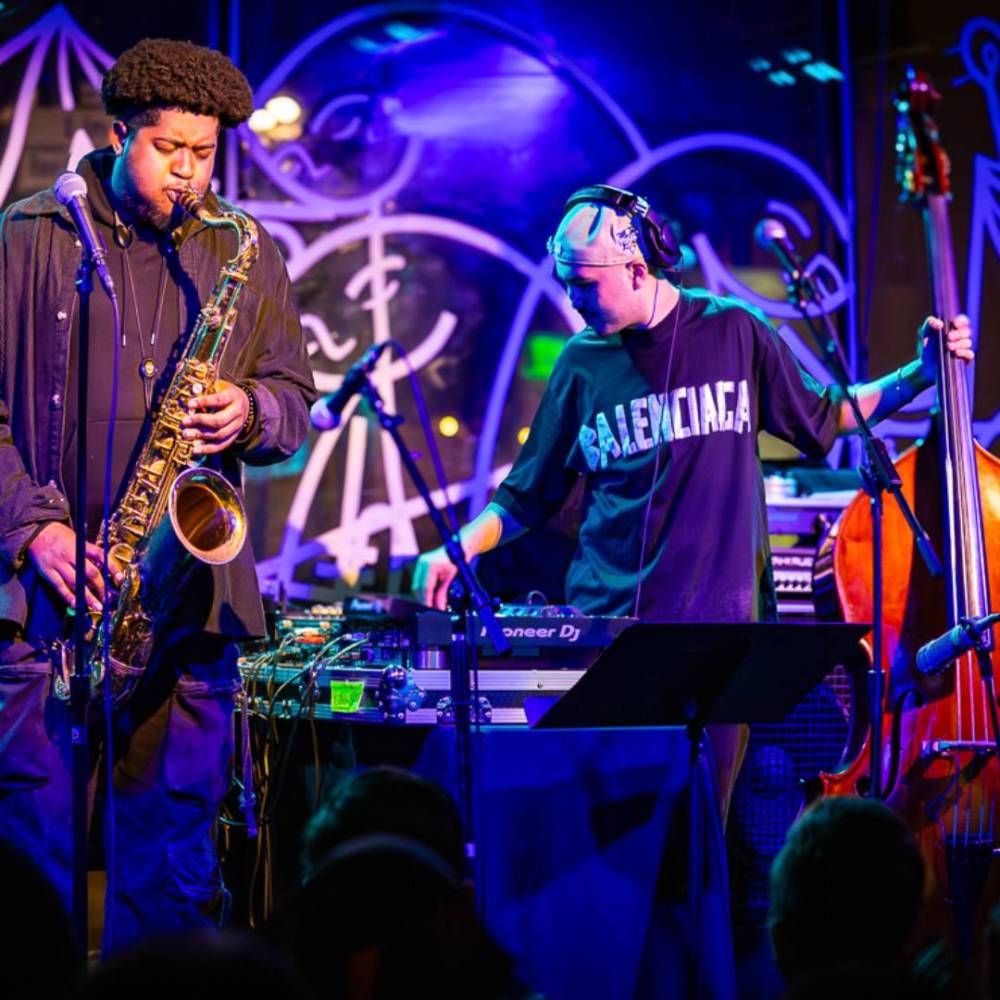
Photo by LJ Rhodes via Noise Pop Industries
Pranav Trewn finds peace in his vinyl record collection.

Most of the headlines in live music are drawn from the movements at the top. We hear about dormant bands returning to play stadiums, concert films by A-listers breaking box office records, and whatever obscene ticket prices Springsteen is currently charging his fans. Yet most of the action in the industry happens at the ground level, in clubs and theaters by acts that most of the population have yet to hear, but gather hundreds of audience members in city after city, night after night.
Each of those venues have showcased key moments in music history, as they often display via archival concert posters strewn across their walls. Save for the occasional Olivia Rodrigo, every household name once cut their teeth on the touring circuit iteratively building a fanbase one show at a time. Even before she became the youngest Coachella headliner in the festival’s history, Goldenvoice booked Billie Eilish in 2017 to play San Francisco’s 250-cap Rickshaw Stop. The next year she graduated to the 700-person Great American Music Hall, before I finally saw her myself play a 3 p.m. daytime set at Outside Lands. For every fan who has since seen her in an arena, there was early buy-in from promoters, agents, and fans that paved the way there.
So what happens to this time-honored pathway when the middle collapses? That’s the question we’ve unfortunately started to answer, as smaller music venues across the country face a grim reality. Chicago is one of the most diverse and vibrant live music cities in the US, with some of my all-time favorite rooms. Yet according to a recent study by the city’s Independent Venue League, three out of four of its them aren’t currently profitable. This is despite the fact that those same independent venues contribute $2.8 billion to the local economy.
This is not just the reality in Chicago. Nationwide, cities are standing by as their historic institutions turn the lights off, casualties of an increasingly hostile economic environment in which – especially post-Covid and in this tariff-kneecapped country – the costs of production, rent, labor, and guarantees have all exploded. Bottom of the Hill, one of the Bay’s best independent venues that has as storied a booking legacy as any, made the heartbreaking announcement at the top of the year that they would cease operations at the end of 2026. Operating costs were a significant factor (they noted that their insurance alone runs them $34,000 annually), but so were changes in demand, in which San Francisco’s ever-rising cost of living has pushed out a lot of the working-class folks that made up the venue’s audience, staff, and talent pool.
The loss of these community institutions is exacerbating the consolidation of the live music industry, a long-running and accelerating movement that has gotten increasing attention as Live Nation more flagrantly abuses its monopoly. Just last month, a map independently investigated and drawn up by European culture networks Reset! and Live DMA demonstrated the extent to which corporate ownership has taken over the sector. A small handful of companies, some whose main business lines aren’t even in music, control hundreds of Europe’s festivals and venues. One of those is Superstruct, whose events, including Sonar, Field Day, and Boiler Room, were subject to recent boycotts due to their parent owner KKR’s investment activities.

So if you are someone who cares about businesses with good ethics, local music discovery, or reasonably affordable entertainment, your options have rarely been so limited. This is why now more than ever, we need to celebrate our independent music venues – not just to honor them before they are gone, but as a means of sustaining and enriching them to persist into the future.
Noise Pop, the annual week-ish long celebration of local independent music culture in San Francisco, has long been at the forefront of drawing attention to the most overlooked vanguards of the arts in the city. Badge holders get access to exceptionally curated, boundary-pushing programming taking place across the hallowed halls of the City still free of Live Nation and AEG’s influence (escaping the fate of our beloved Fillmore, which was acquired by the former in 2007). This includes Bottom of the Hill, as well as homegrown gathering places like Gray Area, Swedish American Hall, Public Works, and Brick & Mortar Music Hall.
Austin Waz is the lead booker and a community liaison for Kilowatt, a Mission District dive that was revitalized by former employees of Bottom of the Hill and fellow independent bastion Thee Park Side (who are sadly yet another recent casualty). Waz is also a musician himself, a member of the groovy psychedelic quintet Analog Dog, and has thus seen firsthand these trends in the live music business from both sides of the promoter / artist index. His work with Kilowatt began when he was asked to produce for Noise Pop a 30th anniversary tribute show, and has since grown into “the best job I’ve ever had.”
For Waz, Kilowatt is more a family than an employer, underpinned by a strong shared value system. “Everything we do is to keep the scene up,” he said. “We make money just to give ourselves and each other sustainable jobs to work in something that we care about so deeply.” The goal is not to compete with rival businesses for market dominance, but to foster an environment in which all the members of the music community can thrive.
This year’s Noise Pop feels like an especially resonant realization of that collectivist philosophy. Over the course of the past few days, I have taken the Muni across San Francisco to catch shows at Cafe Du Nord, Great American Music Hall, and the Chapel, watching neighborhood bands join touring acts on bills that serve as simultaneous showcases of national genres and local scenes. Noise Pop co-promotes shows during the week with the venues, bringing one another ideas and connecting the dots between their respective perspectives. The result is a sum greater than the individual parts, in which artists and operators realize singular lineups that go beyond San Francisco’s already excellent live music offerings.
In the next few days, Noise Pop still has to come the first ever US performance of Lebanese songsman Roger Fakhr, a pair of shows with the legendary Sun Ra Arkestra, and a retro rock dance party by the voice of Spongebob’s band. It’s the type of adventurous bookings that you rarely see anymore from larger promoters, who these days are mostly stringing together trend-chasing touring packages that have homogenized much of the national live music landscape. The result is worse for fans of all kinds, squeezing out less mainstream offerings as the independent venues that would house them struggle to balance their books, and raising prices for the big ticket shows due to the lack of meaningful competition.
Dan Strachot is a managing partner and talent buyer for San Francisco institution the Rickshaw Stop. He illustrated for me how even bands that would want to go independent for their tour struggle to stay true in the face of corporate incentives. “Live Nation can afford to take a chance on a band that is coming through the market for the first time and pay them a little more than us, in the hopes that they can scale them up to a larger venue in the future and make more money then,” Strachot said. “They can offer a $1,500 gas card to offset their costs on the road, and all these other perks that we can’t compete with.”
Once they keep talent away from the independent venues, they can further exercise their pricing power over audiences. As Strachot explained: “If you operate many music venues and larger ones, the higher priced tickets and volume of sales lets you afford to do poorly on some shows. Goldenvoice put nearly every one of their shows on a two-for-one sale this month. They can lose money to get people into the venue, we can’t afford to do that.”
Neither Waz nor Strachota blame anyone at those companies individually, and they recognize that they don’t operate in a silo. “I mean the truth of the matter is that we do co-promote shows with all of those people,” Strachot admitted. “While we are definitely very independent, occasionally they’ll bring us something we weren’t able to get on our own, and we’re happy to do that! I know those people and they’re all lovely, in the general sense.”
But despite their best intentions, those venues are structured to extract value upwards, rather than distribute it outwards. “Live Nation isn’t really any different than Walmart,” Waz said. “It just inflates its own profit, takes tons off the top, and leaves everybody else fucked, you know?”
Rather than compete on those distorted terms, Waz has focused on his venue’s unique offerings. “The way that we work at Kilowatt is community based; we are feeding each other out of a dedication to a lifestyle,” he said. That extends from the staff to the owners, who are involved across every aspect of putting on a show. “Our owner Peter is the lead engineer, and our other owner Rick is the main bar head. They are so involved in the day to day and so passionate about it.”
This is a key distinguishing factor for fans going to an independent venue, and what you see across the Noise Pop experience. “You can’t fake collectivity, you can’t fake dedication,” Waz explained. “When you walk into a space like Kilowatt, with all the art on the wall and the TVs that we painted to spell out the name and the show posters and our beautiful neon sign and the cheap drinks and all these other little individual things – it’s like there’s a literal energy that is embodied in this space that comes from the love and dedication of the ownership and the staff.”
And in spite of the headlines, independent venues are far from extinct. Both Strachota and Waz described their businesses as having strong recent months. “We’re seeing the fruits of our labor and our commitment to the community really kind of come back to us in a beautiful way right now,” Waz reasoned. While by no means making him optimistic, Strachota felt heartened that “the kids are still able to afford to live in this city and are still really interested in making quality, unique music. As long as people are still doing that, we will continue to provide a safe haven for them.”
This uptake of interest in these venues’ programming feels like a reaction to our cultural moment. As I feel my will to live inversely correlated with my screen time, I have found the ability to engage with radical art in DIY rooms to be like a spa for the spirit. Waz believes this is an increasingly common point of view. “With the growing existential dread in America, I think that it’s driving people to more community oriented spaces,” he expressed. “To be a part of things that are local and clearly politically aligned with freedom and connectivity.”
San Francisco has recognized this demand for events that bring the community together, funding initiatives like SF Live and collaborating with promoters on free public performances over the last few years. However, many are skeptical of the sincerity of the city’s commitment. “There are all these classic Daniel Lurie-style videos showcasing everybody outside having a good time, but then you’ve got artists leaving the city because they can’t afford to fucking stay,” Waz lamented. “You have such an insanely gross problem that has gone unchecked for decades now, that you are so in the dark about how to really create protections for the places and the spaces and the people who need protection.”
That’s not to say that the city couldn’t play a bigger role, something Kilowatt staff have been conducting active advocacy around. “I think that San Francisco has a lot of opportunity,” Waz said. “There are so many models of supporting institutions like museums and libraries, things we care about that make our culture better even if they don’t make money.”
“The real key ingredient to a healthy garden is not in planting the tree,” he continued. “But in how you treat the soil.”
Whether or not San Francisco deepens its efforts to support the cultural and commercial impact of these venues, they will continue in their mission to nurture the arts in our hometown for as long as they can. Strachota likened their effort to parenthood, in which you give your child opportunities to “show you what they can do, watching and fostering their talents as they get better and more confident and go on to bigger things.” Artists just need the right stage.

We rely on your support to keep POW alive. Please take a second to donate on Patreon!
