
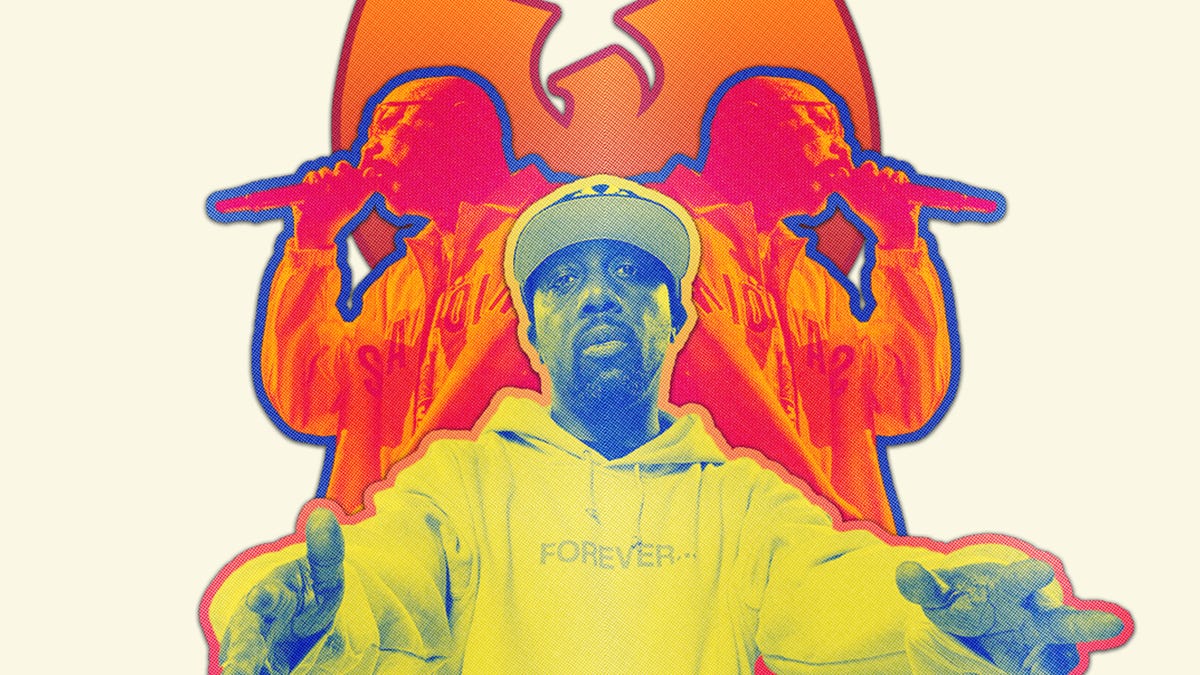
If you pressed a gun to my head and asked me to recite one verse, I’d walk away unharmed having delivered a word-for-word recital of Inspectah Deck on “Triumph.” I mention this not out of pride for my questionable verbal agility, but because on paper, it’s a strange pick: a complex knot of unorthodox vocabulary full of dense metaphors and sharp left turns, standing as perhaps the most roundabout way possible to describe a bank heist. Yet I’m far from alone in my love for bombing atomically. In the decades since Wu-Tang Forever, Deck’s—pardon me—triumphant opening bars have taken on an almost cosmic significance and weight in the eyes of rap fans, becoming a high-water mark for lyrical excellence that also sold a ton of records.
Perhaps less visible however is Deck’s longstanding history of stealing nearly every track that he features on. The received logic is that Dirty was the attention seeker, GZA the wizened OG, RZA the architect, Meth the Star and Rae and Ghost the street cats. In this retelling, Deck is the one who got away: hampered by a solo debut lost to RZA’s flooded studio and a subsequent loss of momentum for the Clan as a whole. In this light, it’s easy to imagine him a tragic figure, the man who could match or even outshine the likes of Guru, Kurupt, Prodigy, Big Pun, Pharaohe Monch, and Kool G Rap but who couldn’t get 12 RZA tracks and a feature apiece from his brothers. So I was surprised, in our conversation, when he proactively brought up the lost album, not as a point of frustration, but as an obstacle he had to overcome and a reality he’s accepted. He’s long since stopped musing on alternate timelines and regrets, instead highlighting the opportunities he did take advantage of, and the unbroken bond he shares with his Wu brethren.
It does help that the man’s spent the past decade spearheading a genuinely inspiring second act, teaming up with indieground survivors 7L & Esoteric to form Czarface and release a series of albums that combine the energy of classic hip-hop with the aesthetics of Saturday morning cartoons. Born of a longstanding friendship—younger listeners should immediately peep “Speaking Real Words” for an uncut taste of what the underground looked like in the late ‘90s—the Czarface project has grown to include collaborative albums with Ghost, DOOM, Kool Keith and, now, one Tom Hardy as Frankie Pulitzer. But beyond the big names, what’s most striking about Deck’s Czarface era is how much fun he sounds like he’s having. It’s all too common for artists to enter the music industry inspired and leave jaded, worn down by bad deals, backstabbing friends, and a general sense of disillusionment. With Czarface, Deck seems to have found the antidote: making records with friends he trusts to provide a classic sound, for a dedicated fanbase for whom hip-hop isn’t just a genre or a culture, it’s a time machine back to their youth.
None of which means Deck’s set his solo ambitions aside. In fact, he’s insistent on the importance of his own records as an outlet for more personal material that neither fits the Clan’s competitive sparring sessions nor Czarface’s high-concept collabs. Fittingly, his recently release, Dragon’s Breath, is a tour de force covering every aspect of his career, from the old school Wu that birthed him on Shaolin 2 to the artists he’s inspired via collabs with contemporary spitters including Ransom, Flee Lord, and Eto. Most importantly, it’s grounded by Deck’s ever forceful, always witty rhyme schemes, which will invariably make heads think Damn, he’s still got it.
Reflecting on C.R.E.A.M. and the Wu-Tang Legacy
I want to keep my hip-hop like the hip-hop I grew up on with Melle Mel. You know: broken glass everywhere. Those are realistic stories before rap got so pretty and so luxurious and so lucrative. I grew up on Biz Markie making “The Vapors” and Slick Rick with “Mona Lisa,” Big Daddy Kane, these legendary artists—that led me to tell my story. Raekwon gave you the actual drug dealer perspective, I was giving you the kid that’s not really clicked up, so he’s out there struggling trying to find his way—I was one of them kids. I was down with the crew and all that, but I chose to be myself. I chose to be the rebel or the outcast, the misfit. That’s just the lane that I chose. There were stories about oppression and about people being deprived. We were the voices in the city saying, “Hey, listen to us. We got a story to tell. Police are beating our ass. There’s no jobs, no housing. You know, we’re living under these poor conditions.” So that’s what the music was used for when I came up. And so I try to give you some of that, you know. That’s what that inspiration comes from, man. You know, it’s a funny, voyeuristic reality, man. I love that reality.