
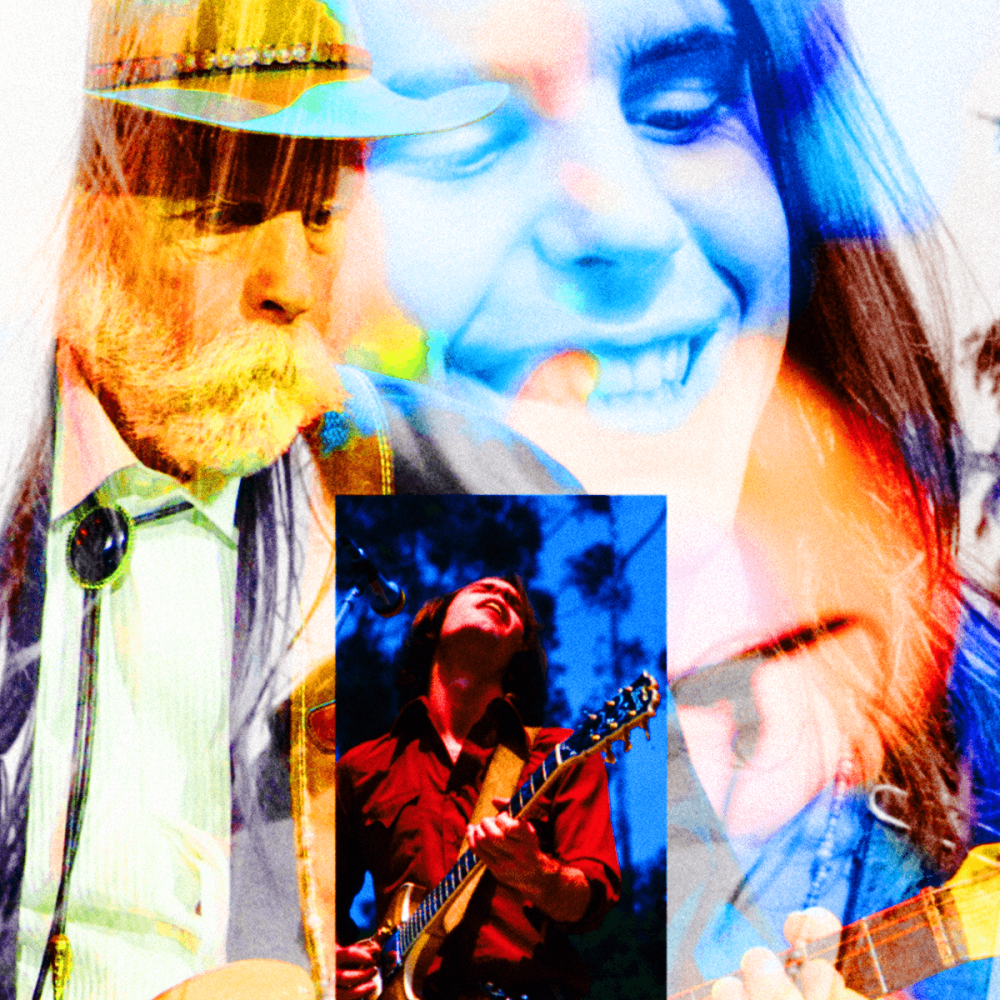
Art via Evan Solano
Sadie Sartini Garner listens to the river sing sweet songs.
For 30 years, he was The Other One. Then, as if the universe felt it owed him another shot, he was simply The One. There he was on a stage in San Francisco, the leader of the band, the kid they once called “The Kid” singing the post-apocalyptic blues of “Morning Dew” from such a depth of solitude it seemed to erase the 55,000 people who were there to see him.
It was obvious, when you saw him up there on stage, that sixty years of soaking in the greatest songbook an American rock band has ever developed had saturated his entire being. Yes, you could read your history and know that there was a time—a long time, most of time—in which Bob Weir was considered unserious. He was vulgar. Not just because of the short shorts, though partly because of the short shorts. He lacked gravitas. You could tell he used the word “boogie” in conversation. He didn’t have the otherworldly glow that Jerry Garcia, himself a sublimely unserious person, was said to have emanated.
By the time he formed Dead and Company with former Grateful Dead drummers Mickey Hart and Bill Kreutzmann in 2015, Bob Weir had aged past all of that. Jerry’s corporeal form had been gone for twenty years, but it was starting to feel as though his spirit had migrated into his bandmate’s body. Though he’d always been fresh-faced and occasionally even sexy, Weir was suddenly gray and shaggy, his hair and beard a blown-out white tangle, his gait a stoned shuffle as he walked across the stage. He had tasked himself not only with finding new wrinkles in songs he’d been singing since he was a teenager, but with carrying the psychic burden of not being Jerry Garcia. At times, he was seen by some people as an interloper, simply because he continued to play the music he’d helped enliven every night since 1965.
There are many things that made the Grateful Dead special: the acid tests, their reverence for unfashionable styles of music, their irreverence for everything else, their sincere belief in the perpetual life of every single song, their weird ability to take songs about suffering, betrayal, and, more than anything, death, and turn them into dance music without sacrificing the pathos at the songs’ center. This was a daunting task, one that Weir had primarily ceded to Garcia during the band’s run from 1965 to 1995.
That’s the way this story is usually told, though of course it’s not that simple, as anyone who’s listened to “Cassidy” could tell you. Though, yes, he was the one who did all the screaming in “One More Saturday Night” and the one who insisted they cover George Jones and Merle Haggard and Marty Robbins, he didn’t view those country and western songs (or the piano-pounding early rock pastiche of “Saturday Night”) as kitsch. To him they were no less serious than Garcia’s “Bird Song” or “Eyes of the World” or Phil Lesh’s “Box of Rain.”
With Dead and Company, Weir had to shoulder it all. He had to keep doing the screams in “One More Saturday Night.” He had to make sure Johnny Cash’s “Big River” was still being played in baseball stadiums. More than that, he had to insist on his own dignity. He had to convince one of music’s most devoted—and thus most discerning, which is to say most judgmental—fan bases that he was properly ensouled and worthy of a song like “Stella Blue” or “Morning Dew.” Maybe “convince” is the wrong word; Bobby never seemed to care too much how he was perceived. His primary allegiance was to the songs, to doing everything he could to ensure they were given the respect he believed they deserved.
In his hands, the songs changed. Weir’s preference for moderated tempos earned the band the nickname Dead and Slow, but by pulling back on speed, he was able to let the music accrue a new kind of mass, like it was tangibly becoming more ripe with meaning.
Sometimes, this didn’t work. Profundity is simply not baked into the DNA of “Shakedown Street.” But when it did work, it could be majestic. Under Garcia, “Ramble On Rose” was a floppy, loping song, something just this side of cheek. The song namechecks Mary Shelley, Wolfman Jack, midcentury evangelist Billy Sunday, Jack and Jill; it’s inessential fun. His voice heavy with history, Weir sang it as if he’d been there when Shelley wrote Frankenstein, like he’d been converted by Sunday, like he’d helped Jack and Jill up the hill. He held himself in reserve for the first half of “Terrapin Station,” emerging like a vista from around a bend to sing the phrase “inspiration, move me brightly” and carry the song into its valedictory second half.
When Garcia sang the same line, he could sound desperate, like he was clinging to a promise. With Weir, it was as though the very idea was being spoken into being. Both approaches work; both do justice to what is one of the Dead’s greatest songs. Slowing the red-eyed reggae of “Estimated Prophet” to a crawl allowed the word “California” in the chorus to transit across the crowd like a sunrise; in those moments, only a fool would not believe in the state’s golden promises.
In his late period, Bob Weir was not the kind of performer who connected with the crowd. Though he wasn’t averse to the occasional pre-show stroll down Shakedown Street, once he was at work, it was as though the legions who packed out stadiums and amphitheaters around the country seemed, to him, incidental. It was as if every time he sang “Days Between” or, especially, “Standing on the Moon,” he had placed himself outside of time. He was communing not even with the many friends and bandmates who preceded him into eternity, but with something inside of the song itself. It was as if to make the thing feel alive and true, he had to treat it as if it were the only thing in his consciousness. Which it probably was. In pursuing the music into its invisible territory, he made himself invisible, too.
When they were at their peak, watching Dead and Company felt like watching an empty stage.
Weir had always operated best when he was just out of sight. Playing in the shadow of a countercultural icon with an instantly recognizable tone allowed him to develop his own idiosyncratic style; when you feel like everyone’s listening to the other guy anyway, you’re more free to take more chances in your own playing. Though he was ostensibly the Grateful Dead’s rhythm guitarist, rhythm guitarists do not play the way he did. Listen to the way he guides “Estimated Prophet” on the February 3, 1978, recording collected on Dick’s Picks Vol. 18.
While Garcia wobbles away with the lead and keyboardist Keith Godchaux works out a Stevie Wonder-style line, Weir is looking askew at the song, perhaps the best one he ever wrote. In one moment he’s clicking away at the changes and keeping time. In the next, he’s comping from a weird angle, like he’s trying to create an unusual shape whose edge lines up with the song’s implied edge—in other words, like he’s outlining the place where the song’s center is supposed to be. It’s like he’s playing out negative space.
Like everyone else in the Grateful Dead, Weir had his long hair blown back by the John Coltrane Quartet at a young age. While Garcia aspired to the saxophonist’s level of instrumental fluidity and Lesh admired the group’s rhythmic complexity, Weir was taken with the way pianist McCoy Tyner framed his bandmates’ playing. Weir famously said he was trying to play guitar the way Tyner approached piano with his left hand. And if you’re willing to, you can hear echoes of the way the pianist would find odd chords that were aching with meaning and use them as a stage for Coltrane’s soloing.
Try to imagine “My Favorite Things” or the opening of A Love Supreme without that elegant setting. Then listen to any live version of “Eyes of the World.” The shuffle Weir plays is crucial to the song’s starry magic, despite Garcia’s lead being the place your mind automatically focuses. It’s the same way the mist is crucial to the rainbow; without it there to refract through, the light remains invisible. But who, when tracing the splash of color across the sky, is thinking about the mist?
We rely on your support to keep POW alive. Please take a second to donate on Patreon!
