
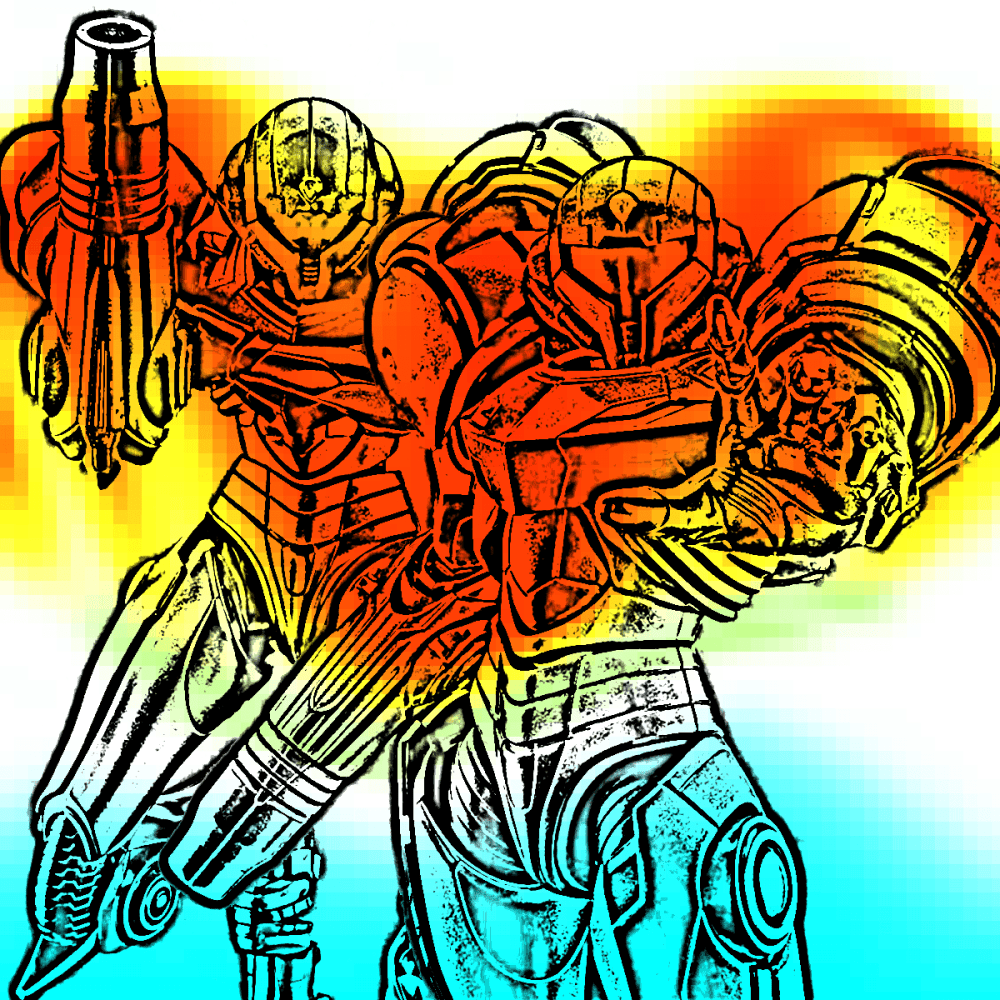
Art via Evan Solano
Dr. Dre’s The Chronic being listed as one of the best Bay Area rap albums is why Alan Chazaro doesn’t trust anything generated by AI.
There’s a moment in Metroid Prime 4: Beyond — the latest installment in Nintendo’s first-person sci-fi adventure series that finally arrived in December after an 18-year-hiatus — when the alien planet of Viewros opens itself before you, and you rip off on a futuristic motorcycle at 700 miles per hour along an interconnected series of metal bridges as rain pours and thunder chisels the night sky above. As you pilot the ever-badass bounty hunter Samus Aran, you can almost feel the windrush coming off the screen of your Nintendo Switch.
The song booming as you accelerate into the cosmos is equally as bold: a Kenji Yamamoto and Minako Hamano-composed banger, titled “Vi-O-La Theme.” It begins playing once you activate the Vi-O-La motorcycle inside an abandoned factory belonging to a nearly-extinct species of psychic creatures (who, despite their advanced technology and teleportation abilities, perplexingly need motorcycles to get around). The track features a slow, choir-like crescendo of baritone voices weaving in and out of the background, anchored by the Metallica-esque shredding of an electric guitar set to warpspeed drumming. It’s fast and unrelenting, much like the moto and its spacesuit-bedecked rider, as you blaze off to the next phase of your mission.
The Metroid series, going back to its Japan-based debut on the original Nintendo Entertainment System in 1986, has carved its own lineage in music history. The rock-n-roll futurisms and symphonic electronica that far pre-date the EDM and Cowboy Bebop fandoms of today are its key signatures. Take the imaginative worldbuilding of Deltron 3030 and the Plastic Beach-era Gorillaz, insert the Swedish Symphony and Tom Morello’s guitar solos, and wrap that in the titanium exoskeleton of Skrillex dubstep slowed to a crawling Adagio BMP tempo, and that’s sort of what listening to Metroid games can feel like.
It’s why Atlanta hip-hop producers and miscellaneous rappers like Baby Keem, Trippie Redd, J. Cole and El-P (formerly of the sci-fi-inspired rap trio Company Flow) have all rhymed over Metroid samples. It’s why European orchestras and death metal rockers have adapted the game’s tunes as covers. And it’s why every genre on the internet from piano-laced lofi to dubstepping EDM has its own Metroid-dedicated playlist.
I’m here to tell you, with all the authority bequeathed upon me by the celestial Chozo gods, that Metroid at-large is making, and has already made, fucking immeasurable contributions to the gaming industry’s audio field, and may just be the most influential, if not purely remix-able Nintendo product ever made (sorry Donkey Kong and Super Mario Bros., but I’ve always been a Wave Beam synther).
The genesis, and genius, of Metroid’s beloved instrumental reputation can be traced back to the aforementioned Yamamoto and Hamano, two of Nintendo’s long-tenured composers who have collaborated on the majority of Metroid games together since the mid-90s, including every Prime.
As told by Yamamoto himself, the original theme for Metroid — an ’80s-bound Chiptune bop characterized by its rudimentary 8-bit soundchips and synthesizers, a style that would later evolve through pop music and electronic house into synthwave and other contemporary genres — was inspired while riding his motorbike home from work as a young Nintendo composer. According to Yamamoto, he pulled over, took off his helmet, and belted out the tune that had been building up in his head into a recorder.
The result is one of the eeriest title screen tracks in gaming lorem at first minimal and spooky, before turning heroic and upbeat. Yamamoto would again supply heatrocks for the game’s sequel in the following decade. Super Metroid — a SNES masterpiece that is revered as being among the most challenging Nintendo games ever released, and which is largely credited for spawning the Metroidvania subgenre of video game design — offers a grip of standout singles, most notably “Ridley’s Theme” and “Brinstar (Underground Depths).”
Prime 4 is the modern rendition of this school, overseen by the same duo of Yamamoto and Hamano. Though it falls short of the pair’s original scores in past Metroid volumes, it delivers a few highlights. Prime 4 has all the quintessential, neon-whirling morph ball action you can ask for, as you pinball your way through expansive tree root systems in the opening levels of “Green Fury,” an untamed jungle where, as per usual, everything is trying to murk you. Here, the game’s OST harkens back to Metroids of the past, with spiritual chanting, twinkling keys and synthy space notes.
It’s appropriate for this point in your quest, in which you’re scantily equipped and only beginning to explore the verdant, wide spaces that await ahead. It maybe doesn’t stir up the same kind of existential dread that might end up in a Baby Keem song, and it’s also not as intense as, say, “RB176 Ferrocrusher” — a track that blares in Metroid: Other M when you combat a weaponized forklift (perhaps the most random, unintimidating boss concept to ever exist). But it doesn’t have to be any of that.
For the hardcore Metroid heads, “Green Fury,” and by extension Prime 4 as a whole, lightly recalls cult favorites like the blizzardy “Phendrana Drifts” from an earlier Prime — and that more than suffices for the occasion. As a longtime Nintendo loyalist (I’ve never purchased a Sony PlayStation or Microsoft Xbox in my life, the gaming industry be damned), I’m certainly biased in my Metroid fanboying, a title that I was introduced to as a form of teenage stimulatory addiction in 2002. That’s when the incipient Metroid Prime came out on GameCube and, to this day, remains one of my all-time favorites, two decades of gameplay later. Prime, much like its spiritual predecessor Super Metroid from the Super NES in 1994, is a masterclass on immersive audio depth with a progressively layered score, in which the further you plunge into the game’s turmoil, the heavier and more crushing the soundtrack begins to weigh upon your silent, cannon-armed protagonist.
I’ll never be able to rewind back to the early aughts, when I was a grungy high schooler living in the Bay, listening to Zion I and Hieroglyphics albums that I’d scrounged up in used CD bins at Tower Records, quietly mastering Super Smash Bros. Melee on weeknights. Back then, I had a beat up pair of Converse, a mop top hair style and rocked a three-times oversized Oakland A’s jersey. The closest I’ll ever get to that as an adult (sans poor fashion choices) is firing up the first Metroid Prime and popping in my AirPods to bask in the soothing pulse of a wave beam cannon blasting above Yamamoto and Hamano’s soundtrack. It’s my personal video game equivalent to The Dark Side of the Moon — wait, maybe that’s an overreach on my part, I admit. I’ll just stick to Dark Samus instead.
We rely on your support to keep POW alive. Please take a second to donate on Patreon!
