
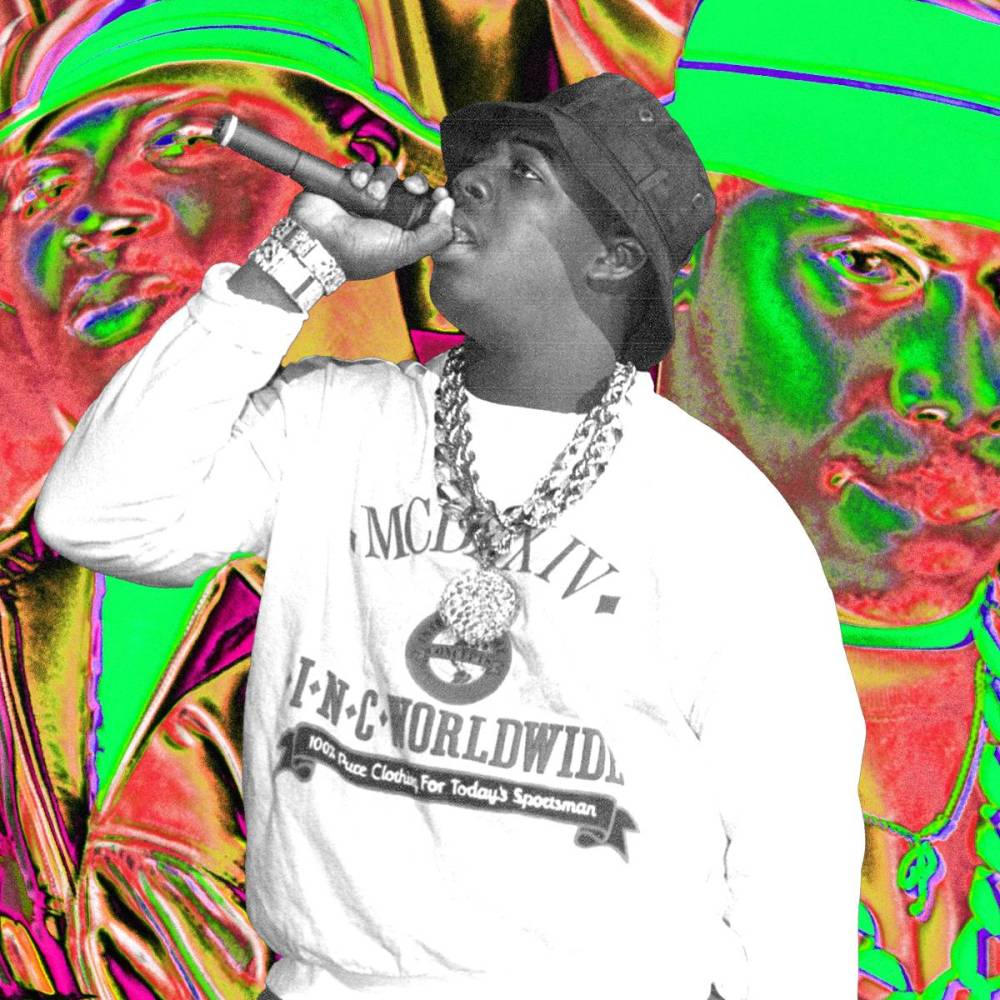
Art by Evan Solano
Thomas Hobbs knows when it’s time to bounce.
Inside the bowels of a smoked-out Los Angeles recording studio, the voice of p-funk pioneer George Clinton howls out eccentric catchphrases (including my personal favourite: “linguistic, full metal jacket of vernacular ballistic”), getting progressively more stoned and erratic as the session unfolds.
The other side of the glass window is the green-eyed bandit himself, Erick Sermon. The producer is attempting to keep a straight face, while pinching himself that he’s finally directing one of his childhood heroes in the booth.
“This was when George was really George!” Sermon reflects warmly over the phone. He recalls the experience producing Redman and George Clinton’s 2001 collaboration, “J.U.M.P.” “George had all these different colours in his hair, and he also had a lot of cocaine [with him]. He’s spontaneously rapping. Me and Reggie, well, we’re recording George and he just starts taking his clothes off in the booth. I’m like: ‘What the hell!?’ It wasn’t the kind of session where you got to ask George Clinton a bunch of questions about the process behind ‘Maggot Brain.’ The vibe was crazy.”
This remains a pivotal moment in the career and life of Erick Sermon. Back when this legendary rapper-producer, and one-half of E.P.M.D (short for Erick and Parish Making Dollars), was growing up in Long Island’s Bay Shore in the 1970s, he studied Parliament’s Mothership Connection vinyl artwork for “hours and hours.”
Right from the start, Sermon’s work alongside the more rock-orientated emcee Parish Smith via EPMD carried a clear through-line with the sticky, trunk-rattling p-funk coming out of the West Coast across the ’70s and ’80s. On 1988’s “You Gots To Chill,” Sermon made Zapp’s “More Bounce to the Ounce” sound like it was coming out of a yellow cab’s busted up cassette player.
With Redman’s 1992 breakout song, “Da Funk,” meanwhile, the Parliament sample and iconic pledge to “let the funk be your guiding light” reflected how Erick Sermon, whether as a producer or an emcee, was the East Coast’s original answer to p-funk. He’s keen to remind me that EPMD made a song with Roger Troutman way back in 1991 (“Everybody Get Up”), and were also interpreting Zapp and Parliament samples, a few years before Dr. Dre started.
“Because where I grew up was an hour’s car ride from New York City, there wasn’t an obvious reference point,” Sermon explains. “It meant we were trying to create something genuinely new-sounding for our hometown. My grandma used to tell me to ‘stay ready’ and to me, that meant trying to sound different to the other East Coast artists. That is what the Def Squad was built on. I actually didn’t visit New York City for the first time, well, until I got famous, and was performing at the Apollo back in 1988.”
Sermon is an underrated figure. EPMD are one of the best rap duos ever, helping popularise bucket hats and Rolex watches as symbols of status within hip hop culture. Sermon’s smooth lisp was also radical for its time: his speech defect wasn’t a weakness, but rather a strength due to how fly it sounded during slurred brags about attaining luxury items. Amid a gnarly David Bowie sample, EPMD’s deep-cut “It Wasn’t Me It Was The Fame” sees a vulnerable yet resolute Sermon famously concede: “I can’t forget how they used to diss / saying he can’t rap as he talks with a lisp / but I got paid… and now they look stupid!”
That’s not even mentioning his work as a producer, with Sermon crafting world class beats and sparking careers for rappers including Redman, Keith Murray, Ludacris, Conway the Machine, LL Cool J, and Jay-Z. Despite having produced so many immortal bangers, for whatever reason, Erick Sermon’s name is rarely featured within the fiery greatest rap producer of all time discussions that regularly occur on social media. Last year he released Dynamic Duos Vol. 1, a solid album where Sermon produced dynamic beats for some of his favourite duos (including Salt-N-Pepa, Heltah Skeltah, Snoop and Nate Dogg, Method Man and Redman, and the Dogg Pound). It’s the first part of a new series that Sermon hopes will force rap fans to re-evaluate his musical legacy.
I listen to a preview of “Kill Shot,” an unreleased Sermon-produced song for Mobb Deep that will appear on Volume 2 of Dynamic Duos [due out in late 2026]. It contains a blood-curdling posthumous Prodigy verse that criticises rap copycats, informing contemporary emcees: “You wouldn’t survive a day in the ’90s.”
Erick Sermon says this particular Prodigy lyric is a mantra for the music he now aims to release across his own veteran years. “Right now, the creativity in rap is super low,” Sermon claims.
From EMPD to losing Roger Troutman vocals, conquering a stutter, and famously paying $200,000 for a Marvin Gaye sample, Sermon sits down with POW to dissect the most important moments from his discography.
I didn’t really start rapping until I moved to a different neighbourhood in Brentwood, where there was graffiti, breakdancing, DJing, and emceeing going on everywhere you looked. They used to call me the pop-along kid, because that was the one dance move I was best at! I met Parish and we started hitting the studio from the age of 16 onwards. EPMD was born.
There were some people in hip hop who picked on me for having a lisp. Ice-T and people like that! They said I had golf balls in my mouth. So, when this album was a success, it felt really good as my lisp became my super power and a signature! The album doing good showed it was a help, not a hindrance. Strictly Business was really about showing the world our musical diversity as a duo.
On there you can hear Joe Cocker, Steve Miller Band, and Otis Redding samples, but also, like, ZZ Top, which we sampled on “You’re A Customer” through taking “Cheap Sunglasses” and removing its guitars. We wanted to be seen as the most eclectic rap group in hip hop. The balance comes from Parish being more rock orientated and having this street reporter energy, and me being more like the funky, laid-back brother you wanted to smoke a joint with. Parish taught me about Led Zeppelin and I taught him about Funkadelic. The balance was perfect.
I remember it feeling like a good time for Long Island rap. When I found out Public Enemy was from here, I was like holy shit! Then Biz Markie, who was our friend in school, he broke out as well. De La Soul and Leaders of the New School weren’t far after, while EPMD had also put Long Island on the map! The second album was about showing the world that this whole regional movement wasn’t a fluke and that we deserved to be seen like another Borough of New York City.
With “Please Listen To My Demo” the idea was to show people how hard we had to fight to make this all happen. Remember: we really struggled to get our record deal! Just because we had blown up, didn’t mean we had to stop rapping for the underdogs. I believe songs like that and “Jane II” resonated with the people because we were being so transparent about our struggles in life.
We were rapping about being jerked around by our label and how to avoid gold-diggers! After the second album came out, I just remember all these athletes, rappers, and celebrities thanking me and Parish backstage or at parties. They wanted to thank us for breaking down concepts like “crossing over” and being used for your money. They felt like EPMD were helping them to avoid the pitfalls [of the entertainment business].
I was sampling Zapp on our very first EPMD album, so working with Roger was fantastic! We went up to his studio in Ohio and just vibed out for hours and hours. A few years after “Everybody Get Up” was created, I remember Roger came to my house and I previewed the beat for EPMD’s “Richter Scale,” which sampled Roger’s work on 2Pac and Dr. Dre’s California Love. He loved it! He then gave me five DATS of unreleased music, which he wanted me to rap on, and I fucking lost them. Heartbreaking, right?
People often talk about me and Dr. Dre, because we both were big on sampling artists like Parliament and Zapp. Some people say Erick Sermon invented all this, but then Dr. Dre took it and enhanced it. Maybe that’s right. But if EPMD doesn’t come out sampling Roger Troutman in the 1980s, I’m not sure Dr. Dre ends up producing “California Love!” For me, when I used a p-funk sample, I always wanted to turn the sample into something else entirely.
These sessions were so much fun! I first met Redman at a club and the second he started freestyling, I automatically knew I found someone special. For “Tonight’s The Night,” I was pairing Reggie up with The Mary Jane Girls and Isaac Hayes… and it all sounded so funky.
I made that particular beat on the Roland W-30. That work station was something special! Because there were so many layers, you could make the samples have a live conversation with each other. I used the W-30 up until about 2001. I saw Pharrell a few years ago and the first thing he asked me was: “Do you have any more W-30 beats?”
Working with Shaq was so dope. We flew out to Orlando and he had a private chef in the studio cooking us up whatever we wanted, whenever. I produced like four songs with him and I co-wrote all of them. People don’t realise Shaq was a huge Redman fan, because he’s from Newark. For me, Big Shaq could really rhyme, for real, for real! But we can’t forget that a lot of people in hip hop turned him down. DJ Premier wouldn’t work with Shaq in 1993! It wasn’t cool to work with an NBA star on a rap album. With the second album, more people like RZA and Biggie wanted to work with Shaq, but that’s because of how we set it off with “I’m Outstanding.”
I had to pay like $200,000 to get those Marvin Gaye vocals, but it was worth every penny. I got a $4m deal [because of the success of that song]. My mother was the biggest Marvin Gaye fan, too, so for his estate to put unreleased vocals in the palm of my hand was a full circle moment. When I rap about making the listener “absorb” the sound, it’s kind of like my mission statement [as an artist]! I want my music to have feeling at its core. The bass should create a chemical reaction inside your body. That’s why you keep coming back to a song like “Music,” because it gives you that rare feeling.
On this song I was rapping about the harsh realities of hip hop, especially when it doesn’t go as well anymore and your “dough gets low.” I wanted the world to hear an honest conversation. The music is more downcast than usual. I love the way Syleena sprinkles her vocals. The E.S.P. album, which this song comes from, is my most slept-on project. I wish the world knew how dope it was!
The idea for this album first came to me during the pandemic. I was wondering why my older colleagues in rap weren’t making rap albums anymore? This was a few years before Nas did what he did with Mass Appeal in 2025. My idea was to make beats purely for the veterans. This then evolved to working primarily with my favourite rap duos, and I wrote out a hit list of 24 groups. It was fun for me to be able to show the world this is how it would sound if I produced a M.O.P. or a Cypress Hill song. My favourite song on this album is probably “Look At Me” by Redman and Method Man. I keep telling them I want to produce a whole new Blackout album for them!
The plan is to release volume two this year. On there you will hear Black Star, Mobb Deep, and The Lords of the Underground, all produced by Erick Sermon. On Dynamic Duos 1, I rap about how we brought Rolexes and Benzes and matching chains into hip hop culture via EPMD. If you see the fisherman or bucket hat, that goes back to some EPMD shit. My rims shop in Atlanta is also one of the reasons you saw all those shiny wheels in so many hip hop music videos in the golden era; Tupac used to come and visit me there all the time! It’s nice to remind the people of this legacy with my new music.
The main thing is I never changed as a person. I’m four or five decades in and I stayed true to my vision, always. I kept it funky! That makes me feel good.
We rely on your support to keep POW alive. Please take a second to donate on Patreon!
