
I have a spreadsheet where I’ve logged every artist I’ve seen perform live. It has over 1,500 entries to date, and within each cell is a story. Most are resonant for a readership of one: when I saw Paul McCartney with my dad in 2016, when I promoted early-career shows for Alex G, Mitski, and Phoebe Bridgers in college. A few recall my personal brushes with history: Frank Ocean’s hallowed FYF 2017 performance to his cursed Coachella 2022 appearance, or when I attended the final Crosby, Stills, Nash & Young show.
I’ve kept this record since my first ever concert, and have appreciated the milestones I’ve recorded since—including celebrating my 1,000th show. I’m not alone in this urge to atomize life into individual data points. In the early 2000s, last.fm accrued a dedicated user base who wanted to “scrobble” every song they listened to into an archive. The motivation to imbue what we consume with a documented significance has since extended to books, movies, and even fitness. Cataloguing is a self-reinforcing practice, in which you generate for yourself an extra dopamine hit not just from experiencing the media, but adding it to your collection.
The Shift to Virtual Attendance
A full 11.5 percent of the performances I’ve seen live have come from Outside Lands, my hometown music festival. It’s become an annual anchor which helps me orient the progression of time. As it happens, life pumped the brakes. I suddenly needed to cancel for the rest of the month, save for Saturday. Although a disappointment, I took it as an opportunity to conduct a natural experiment: experiencing my perennial music festival through the livestream.
Prior to the 1990s, you almost always had to actually be in the room to experience live music. The game changed in 2011, when Coachella partnered with YouTube to stream the weekend across three channels—creating for the first time two prominent but distinct audiences, one in the desert and one at home. It also democratized the medium, giving professional video direction to not just the headliners, but the underground upstarts further down the lineup.
The Digital Paradox
I maintained my initial skepticism on Friday, beginning my virtual festival journey at the main stage. The immediate benefit I had to concede to the livestream was the far better sound mixing, more balanced and clean than the boominess of early day festival sets. I noticed that I felt like an auditor, nodding when things seemed to be going right and armchair coaching anytime I noticed limitations, a dispossessed engagement that differed from how I would have responded in person.
Another clear plus for virtual attendance was the instantaneous speed of travel, allowing me to flip around between acts on different stages without having to spend an anxious ten minutes in transit. On the other hand, I never had to fully commit to what I was watching either. Rather than engage with each performance on its own terms, I could just switch to the other channel, or frankly any other entertainment option within arms reach.
When I was able to stay locked into just the livestream, shuffling between cameras capturing the real life happening not far from my doorstep felt like a reverse panopticon, in which I was a prisoner with 360-degree coverage of the freedom held by others around me. That feeling was compounded by my social media feeds pushing festival content that I had previously appreciated but now enviously tried to flick past.
Reframing the Live Experience
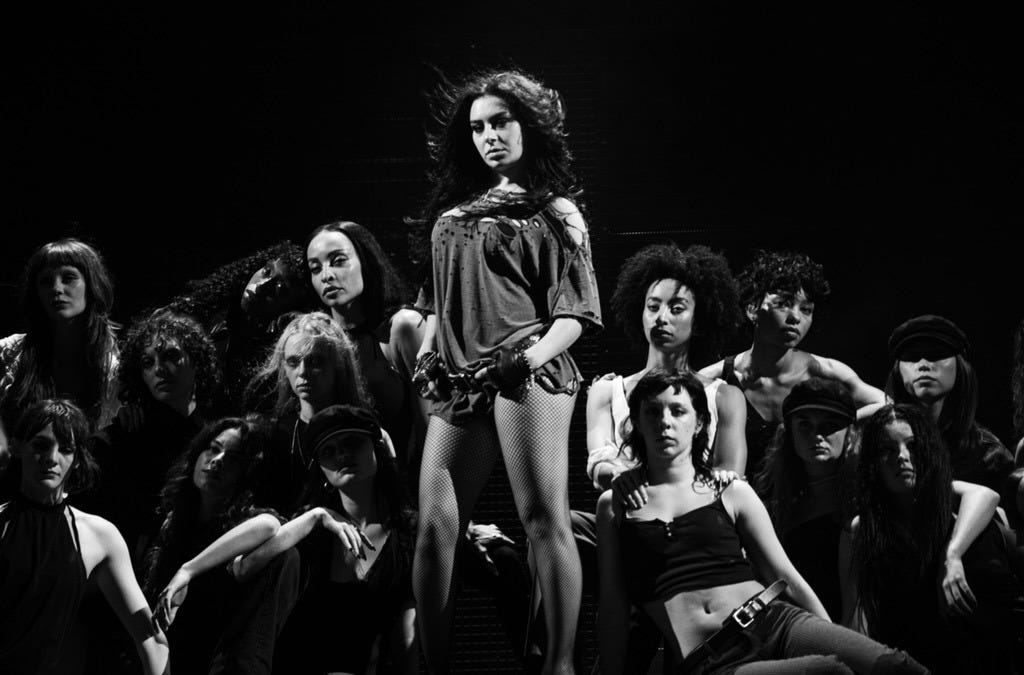
I was most locked in on Friday during the headlining set for Charli xcx. Yet the stream’s shaky cam strobe lights made me slightly nauseous, and while I could appreciate the achievement of her elevated stage show, it felt odd taking it in with so much sustained focus rather than ephemerally via the drops hitting my body and the crowd screaming the lyrics alongside me. I was pushed to form immediate takes about the show that I would never so rashly declare in-person, the internet doing what the internet has long proven itself made for.
The increased visual sharing of festival performances has meant an adaptation of the stage show for the social media era. From set designs to choreography, pop stars in particular have bowed to the demands of the content machine, reaping from the Faustian bargain a double-edged level of devotion from fans. Once you recognize how live shows have been reimagined for these times, it’s hard to see past the Matrix.
Ultimately, I realized the biggest drawback to my livestream participation was that I approached it alone. For any festival, what matters more than any individual name on the lineup is the world you build around the music. Whether at Coachella or “Couchella,” whoever’s scheduled next onstage matters less than the people I get to enjoy the performance alongside.