
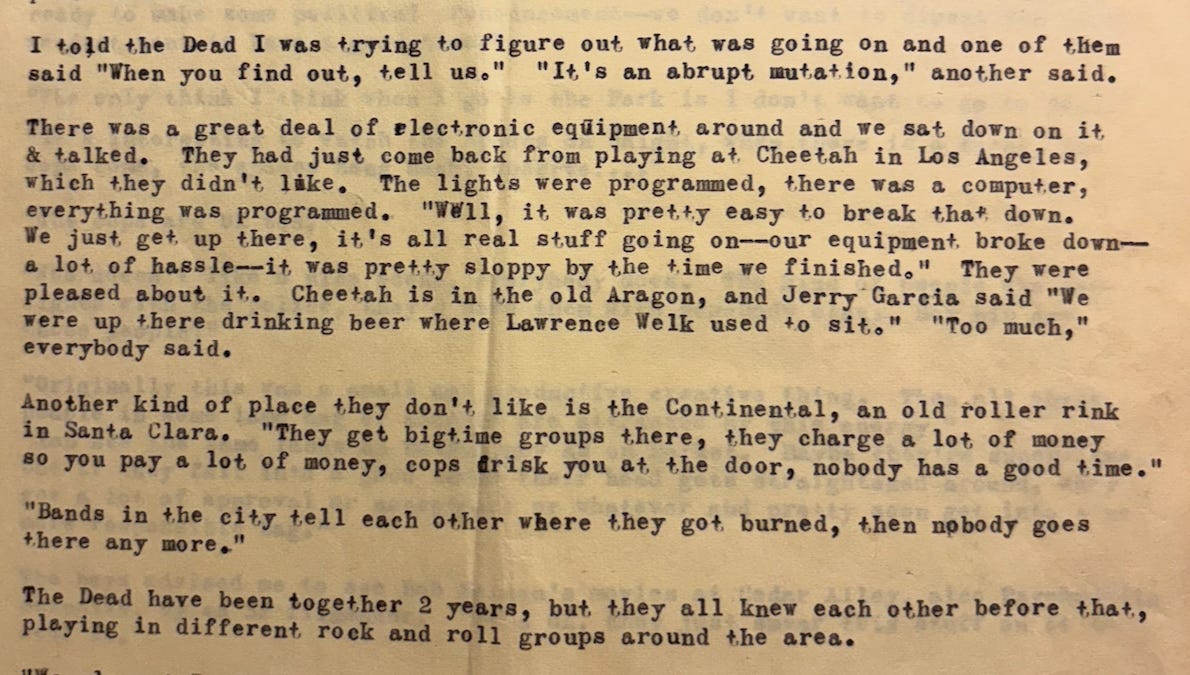
In 1967, The Saturday Evening Post dispatched Joan Didion to San Francisco to capture the cultural seismic shift of the Summer of Love. Among her most intriguing assignments was an afternoon spent with the Grateful Dead, observing the band as they rehearsed behind Bob’s Floating Homes on the Sausalito waterfront. While a brief excerpt from this encounter eventually appeared in her seminal collection, Slouching Towards Bethlehem, the full, unexpurgated three-page essay remained hidden in the New York Public Library’s archives until recently.
The newly surfaced text provides a candid, fly-on-the-wall perspective of the band during a pivotal moment: post-debut album, yet pre-stardom. Didion describes a scene of domestic informality, noting the presence of young women listening to the music, the casual consumption of Cokes and beer, and the band’s own skepticism toward the burgeoning “hippie” commercialism of the era.
Didion’s writing captures the band’s frustration with the “power structure” of the era, particularly the Council for A Summer of Love’s attempts to program the park scene. Jerry Garcia and his bandmates come across as refreshingly unpretentious, wary of the “militant peace” rhetoric and the commodification of their scene. They speak of their music as a genuine, organic endeavor, distinct from the “hippie merchants” who sought to capitalize on the movement.
Perhaps most poignant is the absence of Ron “Pigpen” McKernan, whom the band jokingly identified as their most photogenic member. The band’s banter about a potential Pigpen comic book highlights the camaraderie and humor that defined their early days. As Didion observed, the members were “very engaging and very unpretentious,” offering a glimpse into a group that was, at the time, simply trying to navigate their own creative path.
For scholars of both Didion and the Grateful Dead, this archive discovery is a landmark. It serves as a reminder of a time when the lines between counterculture and mainstream were being drawn in real-time, and when one of America’s greatest writers was there to document the nuance of it all.